|
|

|
|
|
|
Classic Bikes
Custom Bikes
Individual
Racing Bikes AJP
AJS
Aprilia
Ariel
Avinton / Wakan
Bajaj
Benelli
Beta
Bimota
BMW
Brough Superior
BRP Cam-Am
BSA
Buell / EBR
Bultaco
Cagiva
Campagna
CCM
CF Moto
Combat Motors
Derbi
Deus
Ducati
Excelsior
GASGAS
Ghezzi Brian
Gilera
GIMA
Harley Davidson
Hero
Highland
Honda
Horex
Husaberg
Husqvarna
Hyosung
Indian
Jawa
Kawasaki
KTM
KYMCO
Laverda
Lazareth
Magni
Maico
Mash
Matchless
Mondial
Moto Guzzi
Moto Morini
MV Agusta
MZ / MuZ
NCR
Norton
NSU
Paton
Peugeot
Piaggio
Revival Cycles
Roland Sands
Royal Enfield
Sachs
Sherco
Sunbeam
Suzuki
SWM
SYM
Triumph
TVS
Ural
Velocette
Vespa
Victory
Vincent
VOR
Voxan
Vyrus
Walt Siegl
Walz
Wrenchmonkees
Wunderlich
XTR / Radical
Yamaha
Zero
Video
Technical
Complete Manufacturer List
|
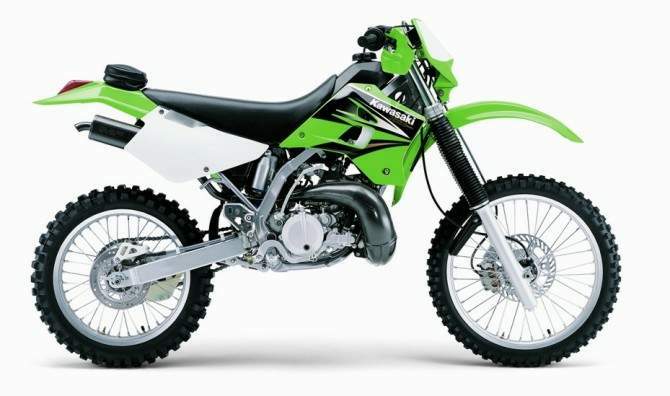
Kawasaki KDX 220R
Kawasaki calls the KDX220R a "do-everything off-road bike", and after riding our test unit for a few months I'm inclined to agree with them. During my time with the KDX, I rode it on trails, fire roads, and even a natural-terrain motocross track that we often use for setting up suspension on our MX test bikes. Despite it's age, heft, and relative lack of power, the KDX220R took everything I threw at it in stride and proved an entertaining and comfortable bike for general riding. The 216cc water-cooled two-stroke motor gives the bike excellent rideability, with smooth power delivery and respectable thrust in the low-end and lower mid-range. For relaxed trail riding the low-end grunt makes it easy to ride smoothly without downshifting too often. However, when riding aggressively, particularly on short straightaways connecting two tight corners, I often wished that the KDX would rev out a little further. The motor feels choked up in the top-end; perhaps a pipe and silencer combo would open it up and give a longer pull. The suspension is softly sprung compared to the motocross bikes I typically ride, but it works exceedingly well on the trail, using the entire length of the stroke to soak up bumps and keep the bike tracking straight. The softer suspension means the bike likes to tackle obstacles a little differently than an MX bike, rolling the back wheel and carrying the front through large roller whoops (BMX racers would call this technique a "manual") rather than skipping over the top. Sharp edged acceleration bumps are a breeze, as the combination of suspension action and a thick, plush seat allow you to stay seated longer on the corner exit, keeping weight on the back wheel without punishing your spine and kidneys. Braking hard into a corner, the KDX forks get way down in the stroke, which is both good and bad. The upside is that the front end dive really loads up the front wheel, giving you more confidence in the front end on corner entry. The downside is that with the fork already way down in the travel from heavy braking, there isn't much stroke left to absorb any sharp-edged braking bumps you might encounter. In this situation the fork can feel fairly harsh, and particularly nasty braking bumps can even cause the front end to bottom. However, unless your local trails are hammered by fast off-roaders every weekend, it is unlikely that you will encounter braking bumps like these anywhere but a motocross track. In bermed or rutted corners, the aforementioned fork dive keeps the front planted as you trail-brake to the apex. However, in fast, flat corners the feedback from the tires is sometimes vague, and the back end can sometimes break loose rather suddenly. Overall cornering manners are excellent for general off-road use, particularly on tight, twisty trails. Source Dirt Riker
|
|
|
Any corrections or more information on these motorcycles will be kindly appreciated. |