Road Test
Five thousand bucks worth of
Image
The Bear got to go out and have his photo taken with it. There's no justice,
is there?
After a few months of gentle per-[ suasion Norm Burling of Burling & Simmons
finally relented and we arranged to take delivery of a brand new Harley
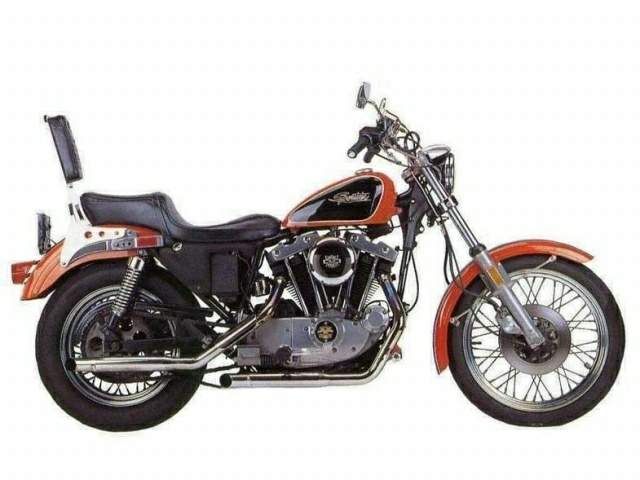
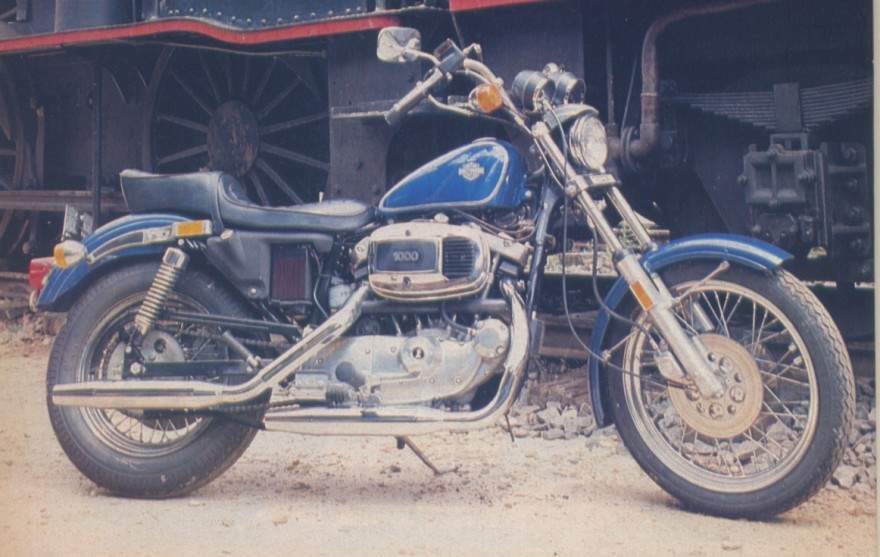
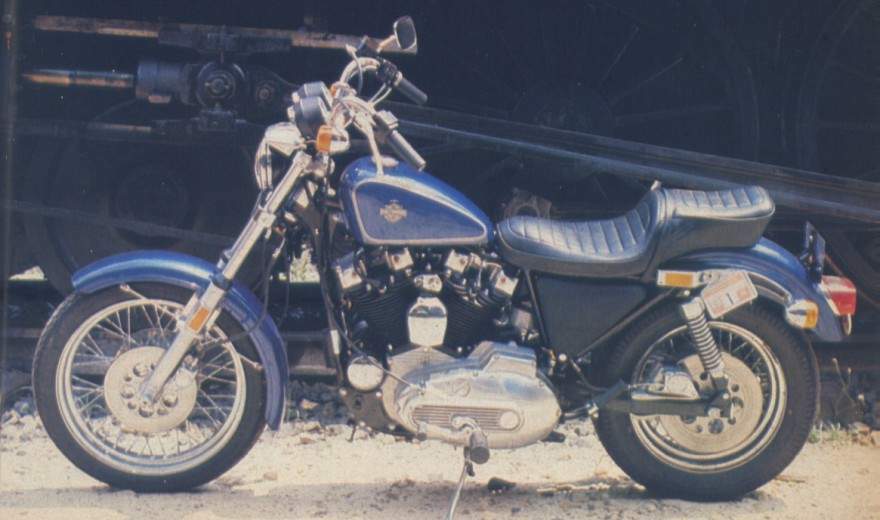
Davidson XLH Sportster.
Having been brought up on a steady diet of oriental motorcycles with the
occasional continental machine our tester felt a little apprehensive when
the day finally arrived to pick up the Harley. Paranoia set in and
uncertainties flashed through his mind. Is the XLH going to be as heavy as
it looks? Are the rumours true about the clutch and will it need two hands
for successful operation? Is the starting procedure going to lead to severe
leg shortening? The list went on!
In fact, all of these fears
proved groundless. The Sportster didn't have a kickstarter, just a very
hefty and efficient battery and starter motor. The clutch was heavy but
certainly not as bad as some (particularly the Laverda Jota), and the 1000
tips the scales at 236 kg dry, much the same as the GSX750 Suzuki.
As soon as one slips into the Harley saddle it becomes glaringly obvious
that this is a motorcycle like no other. From riding position to styling to
mechanicals it's in a class of its own. The company insists (quite rightly)
that its products aren't fast and furious cross country blasters, but are
built to offer durability and character — the image is what it's all about.
Riding the Sportster is to look disdainfully at the GSX leaving a trail of
rubber from the lights. It's amazing to see the way cars give you a wide
berth when their drivers hear the rumble of those exhausts beside them. In
NSW about thirty new Harleys leave the distributors each month and find
their way to terrace houses in Woollahra, mansions in Kirribilli and semis
in Auburn, their owners paying from $5000 to $9000 to become part of the
Harley legend. The people who are buying these motorcycles are about as
different as their reasons for buying them. Surprisingly enough the outlaw
brigade makes up a very small proportion of the total market. Whether it be
for the image, the feel of the motorcycle, or a desire to keep up with the
Joneses, the Harley legend is alive, well and flourishing.
Power, Harley style
Harley Davidson was the first to
the line with an overhead valve Vee twin way back in 1936. The knucklehead
displaced a mean 61 cubic inches (998 cm3) and had such luxuries as a
circulating oil system, hemispherical combustion chambers and domed pistons.
While this may have been innovation then, it certainly wouldn't win any
prizes for design excellence these days. The basic package has remained
fairly similar for nearly five decades.
Outwardly the most obvious changes have involved cylinder head construction,
first the knucklehead, then the panhead and finally the shovelhead. The
original 61 cubic inches has grown through 74 cubic inches (1200 cm3) to 80
cubic inches (1340 cm3). Harley's 1981 range includes only the 1340 cm3
models and the two 1000 cm3 Sportsters, the XLH and the XLS.
Unlike the Japanese who prefer over-square engine configurations, HD uses a
96.8 mm stroke with an 81 mm bore to push out the 998 cm3 displacement. The
long stroke with the high 9:1 compression ratio gives the Sportster its
typical stump-pulling muscle. Crankshaft is a built up affair which
Photography by Simon Hohnen runs on roller bearing mains. Overhead valves
(two per cylinder, of course) are actuated by pushrods with hydraulic
lifters. Cylinders are cast iron but heads are aluminium alloy.
Lubrication is a dry sump system
with the oil tank situated where the left side cover would have been. The
oil tank is a multi-purpose device, it acts as a reservoir for the oil and
as a leg warmer when the bike is at a standstill.
One important improvement over previous Sportsters is the carburetion. The
old troublesome Bendix has been replaced by a Keihin, designed by Harley
Davidson and manufactured by the Japanese company. Another plus with the
1981 XLH is the new Mullard electronic ignition. We found the bike to be a
faultless starter whether it was hot or cold or left in the rain overnight.
With cold start it wasn't necessary to use the choke at all, the correct
procedure involved two pumps of the throttle and a quick stab on the starter
button.
Once underway the Sportster's
unique power characteristics became obvious. The company claims a massive
torque maximum of 69.9 Nm at a very low 3500 rpm, and this is what Harleys
are all about. Heaps of low down grunt promoting easy rideability and
excellent throttle response. In fact the XLH seems deceptively slow because
large increases in road speed come from quite small increases in engine
speed.
Vibration is there, and is certainly not an innocuous feature of the
Sportster. At idle the front end moves up and down in time with the engine
pulsations, while various appendages quiver and shake in a mechanical
symphony of knocks, rattles and chinks. A dedicated Harley rider will tell
you this is part of the charm and we suppose the low rpm vibes could be
excused that way. Not so the high engine speed vibrations! Once the tacho
needle passes 4000 rpm the buzzing gets quite intense and uncomfortable.
Rubber mounted handlebars help to insulate the hands but vibrations do tend
to creep in through the footpegs and tank. High speed cruising (140 km/h
plus) is out of the question unless your posterior and feet lack nerve
endings.
That little pimple on the Harley
frame is the fuel tank. It is fortunate that the XLH is not a greedy
motorcycle because there's only room for nine litres of fuel. A full tank
will last about 220 km on a careful 100 km/h cruise, that's 25.2 km/I (71.7
mpg) — very good for a one litre motorcycle. With round town riding,
consumption will drop to about 21 km/I (60 mpg).
Just cruising Sportster territory is definitely the open road. If you're
cheesed the nine to five grind don't worry too much, therapy is at hand.
It's only a matter of firing up the big Vee twin, fighting your way through
the traffic and taking the closest highway out of town. On a steady cruise
through sweepers and straights the bike is quite relaxing. There's no
adrenalin rush because you're in no hurry to get anywhere. It's not the
destination that's important, but the ride on the way and you'll be able to
cruise at 120 km/h in moderate comfort. At that speed there's no need to
change out of fourth for passing manoeuvres, the XLH has excellent passing
power in fourth from 90 km/h upwards.
If you are in a hurry, the Sportster will perform quite well in the more
open territory. High speed stability is excellent. It feels like a tropical
cyclone would be the only thing capable of throwing the Harley off line.
In the windies it's another
story, the bike isn't at home here. Cornering clearance can be used up quite
rapidly and the steering is slow and not precise enough for optimum control.
When the bike is cranked over round bumpy corners the rider gets very little
input from the steering. In situations where the Harley needs to be thrown
from side to side it demonstrates a reluctance to lean quickly, a factor
undoubtedly aided by the wide rear tyre. Consequently the bike needs more
muscling through windies than one would expect of a 236 kg machine. The
entire setup of softly sprung long forks, stiff rear end, the sixteen inch
rear and nineteen inch front wheel impart a certain unpredictability going
hard round small radius curves.
To be fair, though, the XLH
isn't built for hard riding stunts. If God had meant Harleys to be
scratchers' delights he would have given them flat bars and rearsets but
instead they're adorned with high bars and rider's pegs set well forward.
This riding position, with the easy going power characteristics of the
engine, spells relaxation. To get the maximum benefit from the Harley
without any trauma that's the best way to ride it.
There was one major factor, apart from tank size, which did limit the bike's
long distance touring ability comfort! The rear springs were very
stiff even on the softest of the three settings and the seat, although well
shaped, was a trifle thin in the padding department. After a few hours in
the saddle the rump would become acutely aware of the two frame members
underneath. While the rider slips into the seat and feels safe the pillion
is not so well served. The passenger is perched uncomfortably high on a very
narrow seat and so suffers from insecurity especially under hard
acceleration. Pillion pegs are set too far forward. Bear in mind though that
the XLH Sportster is the budget Harley, the more expensive models have more
comfortable seats.
Cogs and stoppers

The XLH uses a chain primary
drive from the crankshaft to the separate gearbox unit. The XLH chain is
shorter than any of the 1340 cm3 models and Harley Davidson claims this
leads to less drivetrain freeplay and smooth, snappier gearchanges — a
reasonable assertion.
When we took delivery of the Sportster the odometer showed about a mere 10
km so the gearbox was understandably very tight. At this stage gearchanges
were noisy, and successful selection required a lot of muscle-power. After a
few hundred kilometres when the gearbox had loosened up and our tester had
adjusted to its idiosyncrasies, changes from first through to third could be
achieved quite smoothly. Downchanges required greater care and we found the
secret to be "the slower the better". Unfortunately we couldn't accomplish
noiseless changes in or out of fourth.
Due to its massive low rev grunt
the Harley can run fairly tall gearing without problem. Overall ratios are
lower than the Japanese one litre machines. We're sure that Harley could
have rearranged ratios so that there isn't such a large gap between third
and fourth. While this may not be much of a problem when the bike is
completely run in, we found the motor had to be revved past the suggested
running-in levels in third before fourth could be consistently used for
cruising through undulating country.
While the clutch was heavy it was progressive and troublefree — not so the
brakes. Engine braking is substantial but the same can't be said about the
performance of the disc brakes. The
rear disc brake is progressive, quite powerful and needs fierce footwork to
lock up, but the twin discs on the front lack power and feel. From high
speed the XLH needs a lot of effort at the lever to produce maximum braking,
but this does result in rapid reduction in speed. Low speed braking is
better but we found it became a natural tendency to rely more heavily than
usual on the rear brake.
Odds and sods
There's no arguing the fact that
Harleys have unique styling which produces either strongly positive or
negative reactions. It's not something one can really warm to, the styling
appeals or it doesn't. The Sportster's finish was only pretty good. The more
expensive models are heaps better, finely sculptured products. No complaints
about the paintwork though — thick and lustrous.
Switchgear doesn't get top marks. Indicators work only when the finger
remains on the button and the right and left are actuated by separate
buttons on the appropriate end of the handlebars. Quick lane changes can be
difficult since the right hand has to successfully control throttle and
brake application, all with the right thumb firmly on the indicator button.
Horn has a very macho low pitch
and is quite loud. It doesn't really sound like a motorcycle horn so erring
drivers think there is something much larger in their immediate vicinity.
The button is quite difficult to get at quickly because it sits at the top
of the switch cluster.
Headlight was surprisingly good considering its limited dimensions, but the
taillight is disappointingly dull. There's a bare minimum of idiot lights,
just high beam and oil pressure. Unfortunately the XLH hasn't a neutral
light which does prove to be a bugbear. Neutral is very often difficult to
find whether the motor is running or not. For your $5150 plus rego you don't
get a toolkit. Still, what does a brick and a cold chisel cost? The price
does include a comprehensive owner's manual.
Conclusion
There it is! The Sportster isn't the fastest, or the best handler around but
it does have loads of character and road presence. We found the Harley to be
quite easy to live with despite its various idiosyncrasies and the appeal
did grow the longer we rode the bike. It's certainly not the bike for
everyone but at least 80 Australian people every month are parting with a
substantial amount of money to be part of the Harley legend. For the price,
XLH is not good value on paper. But many a Sportster rider will tell you
it's cash well spent. — D.B.
Source Two Wheels 1981