|
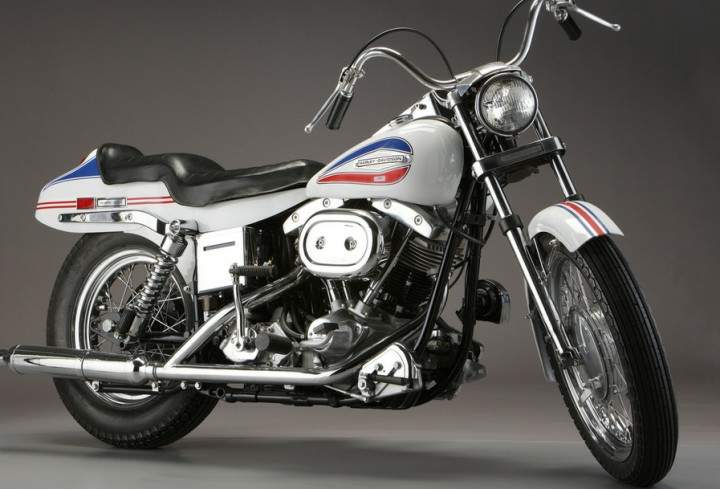
Harley Davidson
FX 1200
“Boat Tail”

|
Make Model |
Harley Davidson
FX 1200
“Boat
Tail” |
|
Year |
1970 |
|
Engine |
Air cooled, four stroke, 45° V-Twin, OHV, 2
valves per cylinder. |
|
Capacity |
1207 |
|
Bore x Stroke |
87.3 x 100.8 mm |
|
Compression Ratio |
8.0:1 |
|
Induction |
Single 38mm Keihin carb |
|
Ignition /
Starting |
- / electric |
|
Max Power |
65 hp @ 5500 rpm |
|
Max Torque |
|
|
Transmission /
Drive |
4 Speed / chain |
|
Front Suspension |
Telescopic forks |
|
Rear Suspension |
Swinging fork. |
|
Front Brakes |
Drum |
|
Rear Brakes |
Drum |
|
Front Tyre |
3.25-19 |
|
Rear Tyre |
5.10-16 |
|
Weight |
|
|
Fuel Capacity |
12.5 Litres |

With a gap between the smaller XL models and the
larger FLBs, Harley announced the all new FX series for 1971. By joining the
frame of the FL with the suspension of the XL, Harley hoped that the latest
entry would appeal to a wider audience. The unusual boat tail rear fender
that was first seen on the 1970 Sportsters was also installed on the FX.
While the styling was certainly different,
The motorcycle world has always been divided into two major
camps: factory production machines and custom bikes.
From time to time, though, a company will try out new ideas
with a “factory custom.” The result isn’t always a success on the showroom
floor, but these motorcycles are often influential for decades after their
creation.
The American motorcycle scene of the late ’60s and early ’70s
provided the perfect breeding ground for such experimentation. Bike sales were
rising toward record numbers, and Japanese companies were redefining streetbikes
with such landmark machines as Honda’s CB750. Meanwhile, American customs were
gaining recognition as a unique style through exposure in movies like “Easy
Rider.”
In the midst of those dramatic developments, Willie G.
Davidson sat down to sketch a new bike for the company bearing his name. Taking
note of the custom scene, Willie G combined the 1,200cc motor and frame from the
company’s Electra Glide with the chopper-style front end from the Sportster. He
added a Euro-inspired fiberglass seat/tail section for a unique look, with wide,
bold graphics.
The resulting machine, released in 1971 as the Super Glide,
was not an instant success. In particular, the “boat-tail” rear was a bit much
for most American buyers.
But the notion of a lean, muscular cruiser caught on in a big
way. Once the tail section disappeared for ’72, the Super Glide developed a
following, spawning the FX line of Harleys that has continued for more than 30
years, through the Low Rider, the Wide Glide, the Sturgis, the Softail and the
Deuce.
|