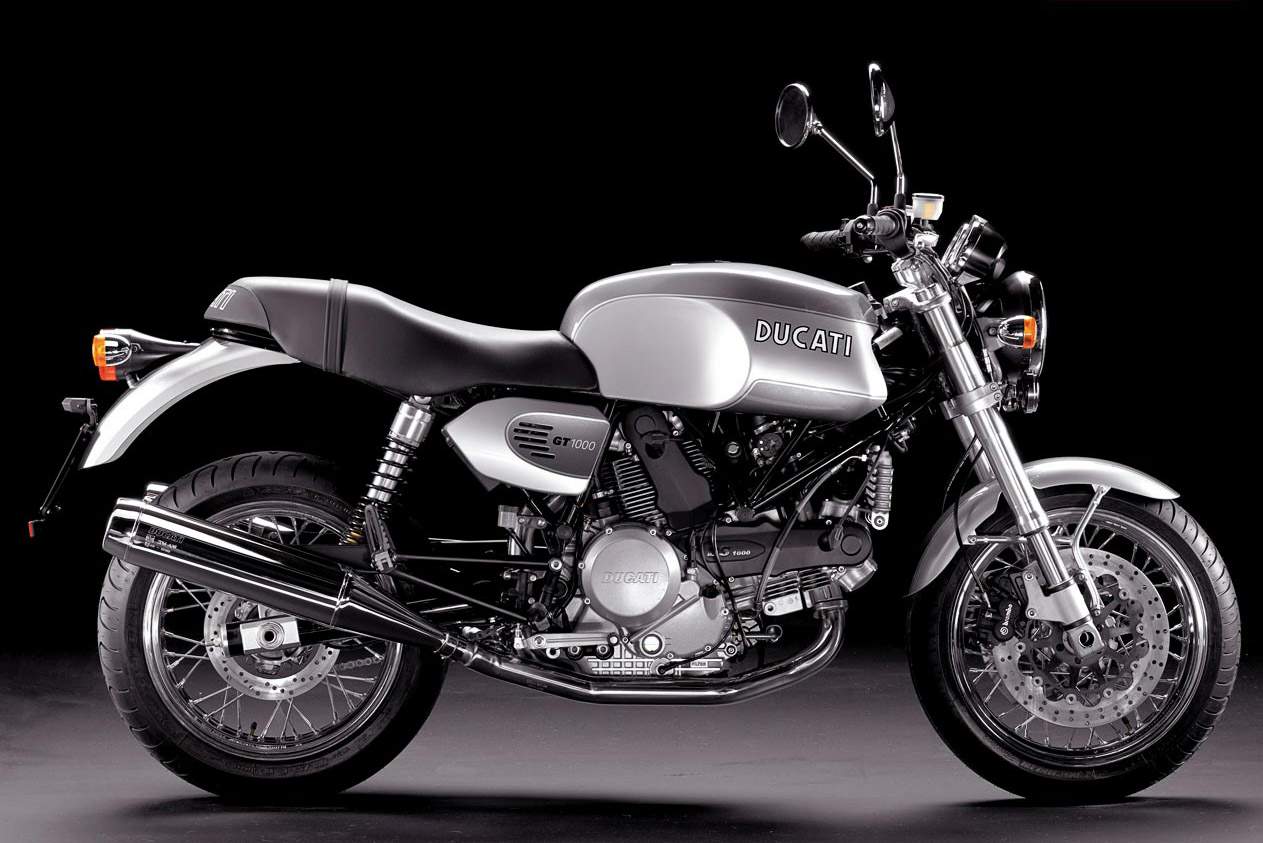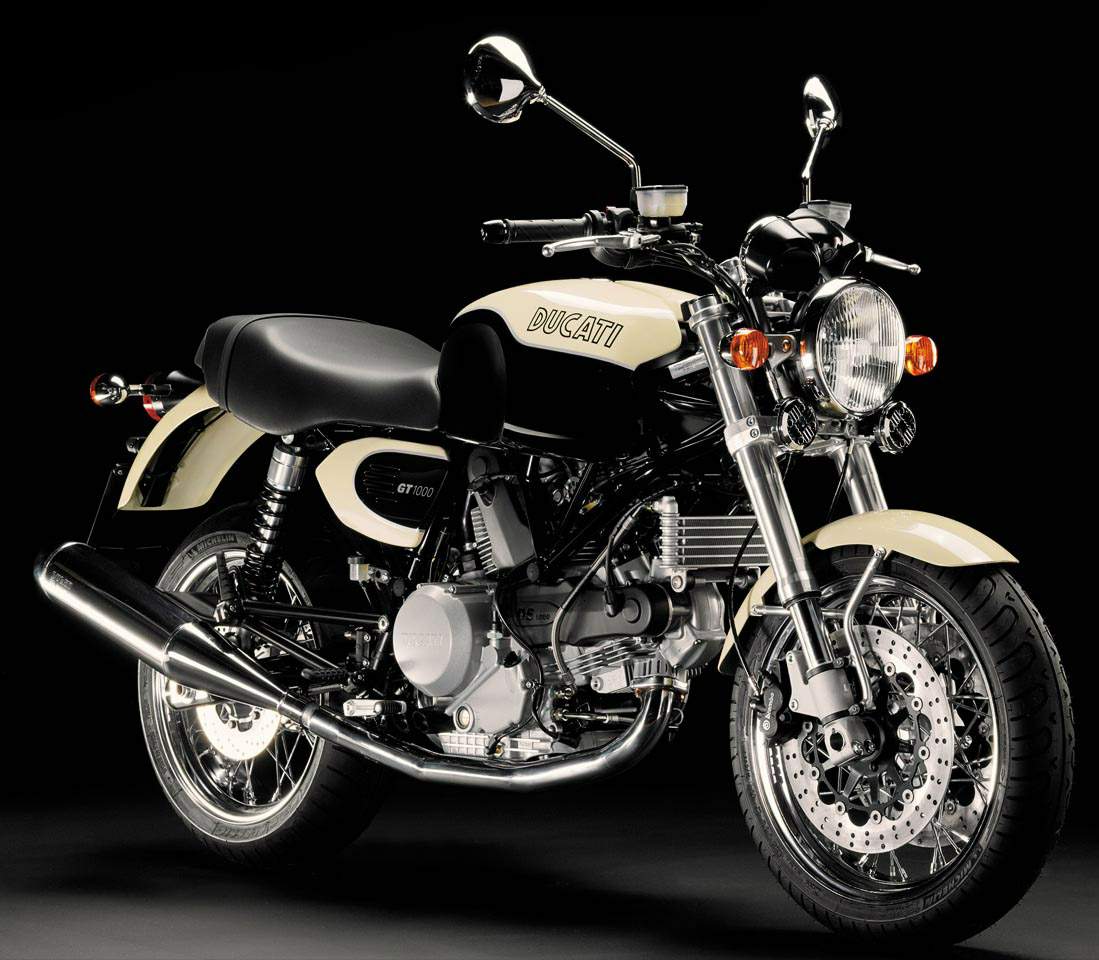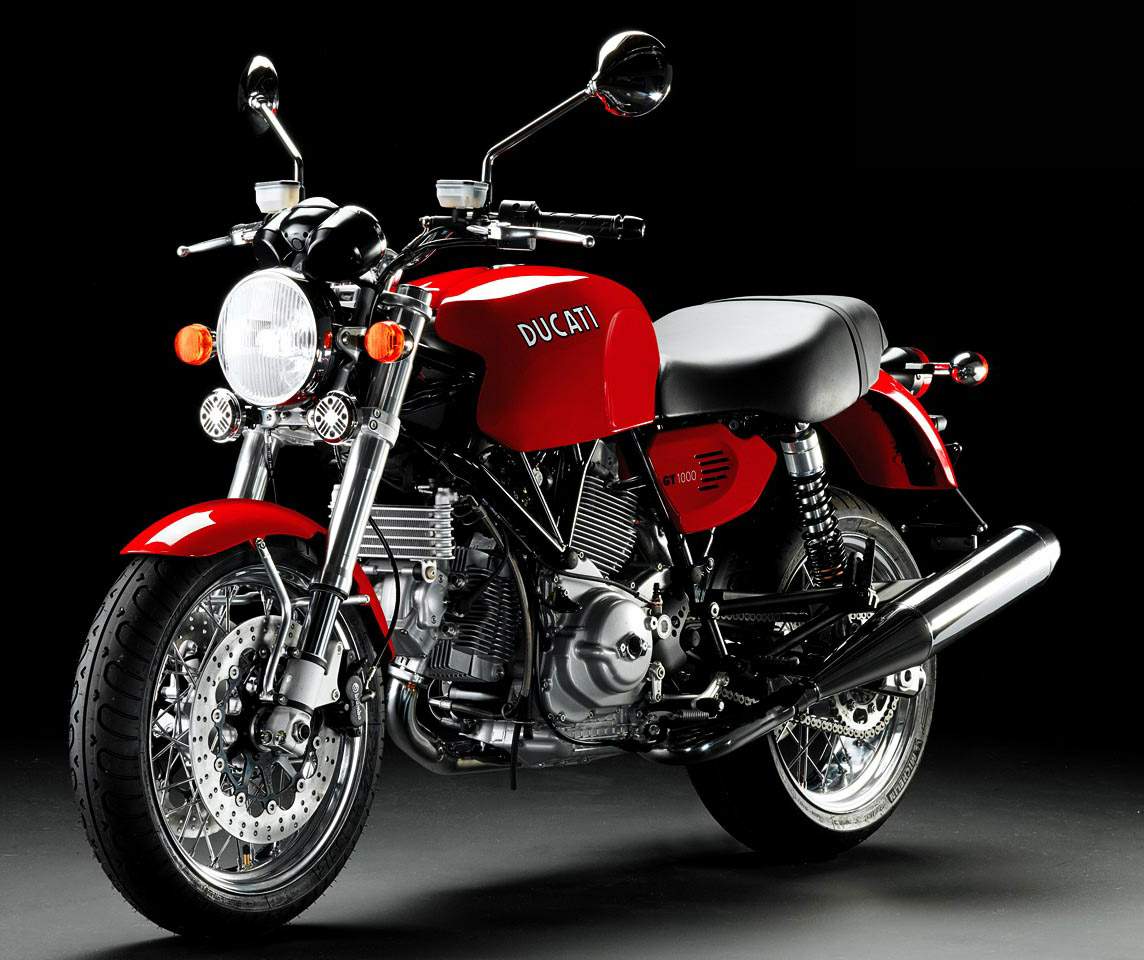
The Ducati GT1000 offers the best of two
different worlds – elegant styling that harks back to a different era, combined
with contemporary motorcycle technology, which makes it safe and reliable. Retro
styling cues are everywhere – large, generous double seat, twin rear shocks,
wire-spoke wheels, steel tube chassis and even the way the headlamp and taillamp
look – everything looks like it’s from a different age.
And yet, even though you may not be able to spot them immediately, there are
modern bits aplenty on the GT1000. For example, the 43mm USD Marzocchi fork,
twin 320mm brake discs (front) and 245mm disc (rear) and the tyres, with their
modern tread pattern.
The GT1000, which weighs 185kg dry, is fitted with Ducati’s 992cc air-and-oil
cooled v-twin, which produces 92bhp at 8,000rpm and 91Nm of torque at 6,000rpm.
Get on to the bike and it feels light and incredibly comfortable – just right
for slicing through city traffic. And even at low revs, there’s always a hint of
that special Ducati character, a glimpse of the bike’s ‘fighting spirit’ that’s
just waiting to surface.
The GT1000 is, of course, all about looking good...
Up in the winding roads in the hills of Bologna, the GT1000 builds speed quickly
and effortlessly. The Ducati engine, which is all aggressive at lower revs,
seems to calm down as the speed builds up, while the handling remains spot-on.
The bike corners with confidence and stability – the rider always feels
completely in control and completely safe.
Now, while the GT1000 is happy being ridden fast, you may actually enjoy the
bike more if you slow down a bit. It’s the type of bike on which you’d want to
look around a bit, enjoy the scenery. This definitely isn’t about performance
calibrated to the last hundredth of a second – it’s about style and turning on
the charm…
The GT1000 has no storage space, but that’s a problem that the touring version –
with its saddlebags and high windscreen – should take care of. At €10,300
(US$13,100), the GT1000 probably isn’t for everyone. But then stylish,
sophisticated Italian motorcycle like this one can never be cheap.
Review
Getting enthusiastic acclaim for
wild retro show models is one thing, but selling them come Monday is quite
another. I find it hard to believe that anybody in Ducati could have suspected
that three years after the Sport Classic models were unveiled in the Tokyo show,
that these would become the top sellers in the Bolognese firm's line-up.
Yep, more than 30 percent of overall Ducati sales in countries like Germany, the
UK--and the USA too, according to the rumors--are the new Sport Classics. I can
understand the 40- or 50-something bloke's fascination with the Paul Smart 1000
and Sport 1000 but I must say that the model I was looking forward to ride the
most was actually the last release in the Classic trilogy: the new GT1000.
The two aforementioned models have the oh-so-cool boy racer pose, but after
riding the Paul Smart 1000 (The Sport is basically a PS1000 sans fairing), I
understood that my lower back isn't super keen on clip-ons that feel as if they
are bolted to the front wheel spindle. But this new GT...Well, it looks like a
much better and more humane proposition. It has a proper standard handlebar, a
big, flat seat (the two sport models are single seaters) and pegs in the right
place. Maybe it's an emotional thing after all. I was reared on seventies
standards; my first Japanese bike after a string of British singles was a 72'
CB500F. It was definitely not a road-burning café racer, so my definition of a
proper classic is the do-it-all, normal seating position motorcycle, just like
this Duc.
Park a GT 1000 next to its sportier brothers and you'll be hard-pressed to
notice the very same basic frame beneath the vastly different looks. For
instance, the GT 1000 has twin shocks while the sporty twins sport just one
(asymmetrically mounted). This is because when Ducati and Treblanche set about
working on these Classics they created a modular frame that could be adapted to
the diverse configurations. The GT's rear schwinger also has twin oversized
straight tubes rather than the "banana shaped" right side arm of the PS/Sport
1000 but those are the most notable mechanical difference.
As in all the latest 1000cc air-cooled Ducs, Classics included, power is
supplied by the twin-spark two-valve mill. Claimed power nowadays is 92 hp @
8000 while claimed torque is a healthy 9.3 kgm @ 6000.
On paper the specs might be similar but in real life the GT 1000 couldn't
be--and feel--more different. Inspiration for the GT 1000 comes from Ducati's
first big bike ever: the GT 750 of 1971, the first Bolognese V-Twin model sold
to the public. Like its new incarnation, that GT750 was a very
normal-configuration roadster, worlds apart from the tiny super sporting singles
that Ducati produced till then. The "Grand Turismo" moniker was very apt, since
factory-mounted fairings were a real rarity at the time.
The trouble for that first GT was that after the win at the 1972 Imola 200, the
spotlights in Bologna were aimed back again at the sporty side of the range; the
Super Sports. The original GT--never a thing of great beauty, to be honest--was
pushed aside a bit and a total facelift in 1975 by famous car designer Guigiaro
only made matters worse. We all know what happens when you give car designers a
go at two wheelers, don't we. The GT860 was a very bizarre-looking piece.
'The end result has character in spades; that rectangular cut gas tank is the
Seventies at their best and the smallish side panel underlines its size.'
The later (and way sexier) Darmah again tried to offer a touring tool for true
Ducatisti but by that time the twins had become synonymous with hard-core
sporting machines. Nevertheless, the concept of a large Duc with relaxed ergos
remained embedded in our collective memory, and considering the typical back
problems of current bike buyers in their forties and fifties, was deemed as very
rational. Treblanche took only the spirit of the GT's, a sort of purposeful
modernist style and translated it to modern times without trying to mimic the
exact shapes exaggeratedly.
The end result has character in spades; that rectangular cut gas tank is the
Seventies at their best and the smallish side panel underlines its size. Like
with the Paul Smart, you can see the huge effort applied to create a harmony as
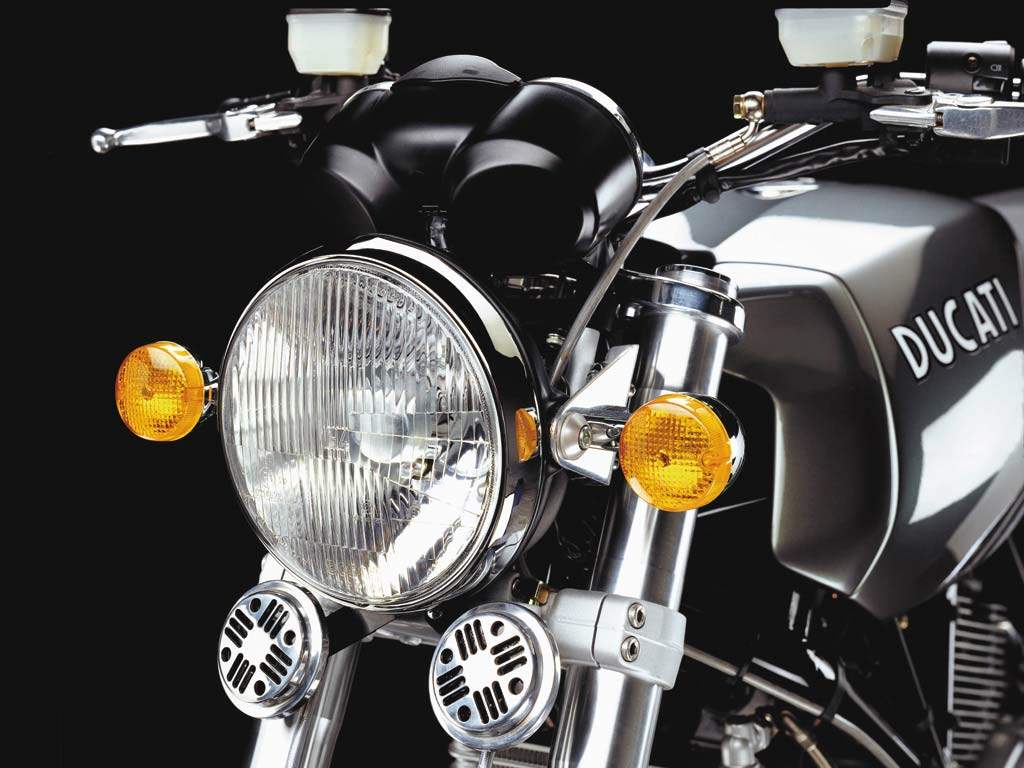
good as that of a period Beach Boys tune. The sheer impact of that huge
headlight and those twin chromed horns, the tubular front fender brackets, the
chrome accents on the clocks, the classic rear lamp/indicators cluster and let's
not forget that oh-so-seventies white Ducati logo.
They almost succeeded in getting it just right. Why the "almost"? 'Cause the GT
1000 looks damn perfect from most angles but then from others you suddenly
notice the huge gap between the rear wheel and the fender. Sheesh... somebody
could sleep in there! Then there's the big distance between the silencers; the
rear view of the bike is almost grotesque, especially compared to a true
Seventies Duc. I guess that there must have been some serious mechanical
constraints dictating that splay between the cans, but that super sexy,
skinny-Twiggy rears of Ducs of yore got lost somewhere and it's a bit of a
shame.
But do take my comments about proportions with a pinch of salt. I can't remember
many bikes that produced so many comments from bystanders, so many desiring
looks and indecent proposals, whether from men, women, kids or the elderly. The
GT's classic good vibe penetrates walls, also enchanting people who weren't even
born back in them Seventies. So it's a big thumb up for Pierre and the boys in
Bologna; they hit the nail in the head styling wise.
'Let the rev needle steady at a lazy 5000 and the GT 1000 runs unfazed at a nice
95mph.'
I had fallen for the GT immediately but for entirely different reasons. It
started in the "Ducati Milano" dealership parking lot, exactly ten seconds after
positioning my bum, feet and hands in place. A Normal Ducati at last! YEEEEE
HAAAAA! Normal, standard, human, plain nice. Is that clear? The shock waves
continue as I hit the busy streets. Why did we have to wait till 2006 to ride a
Duc that's so damn easy to manage, with that wide lock-to-lock steering angle
that lets you take advantage of gaps in traffic with ease, or the overall
scooter-like ease of use? May I ask, what's that supposed to be? A real
lollypop, that's what.
After the harsh S&M session I had on the Paul Smart it's hard to believe that
this bike stems from the same basic frame and mechanics yet feels so entirely
different. Just as well, when your hand and feet are positioned so naturally,
all controls work much better, are easier to operate (clutch is now a wet
affair) and you can glide along in a buttery flow. The gearing feels slightly
shorter than in the PS 1000, which makes take-offs from standstill easier. Give
the clutch 30 feet of forward movement to get coordinated with the engine speed
and from 3000 rpm on you'll be rewarded with a very healthy and merry thrust
from the well-injected V-Twin. This thing is such a joy to commute on--much more
so than any Monster--that I happily use it for my daily commute to work during
the week, Milan traffic and all.
Nice urban manners are important if you are a hard core Yuppie doing a posing
round through different Starbucks locations, and the GT will be indeed a great
tool for the job. Smart espresso-sipping chicks are going to dig it. Thing is,
that there are no Starbucks in Milan (luckily) and in any case, I'd rather check
out how Grand is the "Turismo" bit in the GT's name.
So on to the highway then. With not much of a fairing up front there is a
considerable blast to resist but my youth on standards have taught me to not pay
much attention to such minor distractions. Let the rev needle steady at a lazy
5000 and the GT 1000 runs unfazed at a nice 95mph.
Back in '78 I used to buy the British magazine MCN weekly and was often
attracted to the tall, scantily clad models that Coburn and Hughes--the Ducati
importers at the time--would place on top of the bikes in their ads. Well, this
GT 1000 feels just as long-legged as those handsome gals with the way it simply
swallows the miles. This is exactly the moment when I recall why I still like
late Seventies and early Eighties dinosaurs so much. Want to change position
from sit up and beg to something sportier? There's no need for fancy aftermarket
rear sets and clip-ons. Just like in any KZ1000 or CB750 of yore, simply slide
your considerable butt rearwards on the flat seat and hey presto! You are in a
classic road tearing-position! Still not comfortable? You can put your feet on
the passenger pegs and blast the last 60 miles to your exit at 115-120 mph in
true Burt Munro "The World's Fastest Indian" style and that's exactly what I do.
Brilliant!
Sport riders might laugh at my boasting about 120mph but I can assure you that
120 on this fairing-less Duc is way more interesting and fun that 160 on your
typical crotch rocket; there something utterly manic and raw about it. The
90-degree Vee might be in theory perfectly balanced but there are enough vibes
to remind you that it's no four-pot sawing machine churning out the horsies down
there. Obviously the helmet does get hit by the wind blast even while laying on
the tank but at least its clean, non-turbulent air, so it's not that bothersome,
all things considered.
In the tighter stuff, I discover that even the GT has a sporty side to it, and
that it's a great leaning partner. The wide handlebars, sticky tires (Michelins
radials with period looking tread design but modern compound) and sporty
suspension let you squeeze cornering performance out of the retro GT that is
right up there with the sporty Monster.
'It's hard not to fall for the old school experience that this GT 1000
supplies.'
It's also on twisty roads the GT shows a totally different attitude than the
Paul Smart. The clip-on equipped PS 1000 is a good handler but nowhere as
manageable as this GT. It's not as if the GT feels like a flyweight when
throwing it around but it responds readily to proper handlebar inputs and when
laying low on its side, lets you draw nice arcs around the apex. Twin shocks in
the back might be almost prehistoric nowadays but when they are well calibrated
and coupled to a stiff frame and sorted front, they can supply a satisfying
sporty experience.
Things change quite a bit when the road is less than perfect. While passing
through a small town with cobblestone streets, the GT jumps about abruptly,
almost unpleasantly so. The USD fork and massive shocks might look good but more
sophisticated hydraulics inside could help.
All this is forgotten as I power on again. It's hard not to fall for the old
school experience that this GT 1000 supplies. The lively torque pull you smartly
out of turns, the reassuring handling manners let you get away with respectable
lean angles and when your boot tips finally skim the tarmac, you feel a bit like
Mike Hailwood making his TT comeback. The guy used to wear through his boots
until his socks showed and toes bled: that was his measure for lean angle, or so
the story goes.
Obviously these heroics happen at much less impressive lean angles. Pegs might
be a bit low by today standards but I'd rather keep them that way for the extra
leg room they provide. One thing to keep in mind is to keep the revs above
3,000, not for lack of drive but rather because of the noticeable shaking that
the power pulses produce when rolling the throttle back on.
I reach my girlfriend's house and she's quite excited by the "red bike" even if
she's far from being knowledgeable about motorcycles. It's interesting how even
someone who doesn't have much of a reference to old classics can nevertheless
perceive that period vibe.
Off to town we set and the rear seat gets good marks, the only complaint being
the quiet farting from the silencers. Well, it seems like she is more
knowledgeable than I care to admit, because she's right. You'll need to drop in
a pair of Termignionis for the right aural effect. So-so marks go also to the
floating twin piston calipers and the slightly cheapo mirrors. But again, keep
these comments in proportion.
'The visual charm was clearly evident from the 2003 Tokyo show pictures and it
gets only better in person...'
As we stop in the town center, a small crowd gathers and the inevitable old guy
approaches me. "Used to have an old 860" he goes. I ask him to sit on the GT and
he says: "That 860 was longer yet this one feels very familiar.. bene, bene. I
still regret selling that one when I got married..."
After such a verdict, I can say it for sure; this GT 1000 is going to do a lot
of good for Ducati. The visual charm was clearly evident from the 2003 Tokyo
show pictures and it gets only better in person (well, mostly). Then there's
that surprising efficiency as an everyday ride but I could expect even that. The
real surprise is how such a retro-roadster can feel so Classic and yet so modern
at once; it'll still take me some time to grasp the apparent contradiction.
NOTE: Some of the photos on
Motorcycle Specs are owned by somebody. If you see any of your
photos, you can let me know so that I can acknowledge it, or if
you object to it, I can remove it altogether. If any copyright
holder objects to their articles being placed on Motorcycle
Specs, it will be removed upon request. Any correction or more
info on these bikes will kindly beappreciated
Contact MePrivacy
Policy
Website Stats