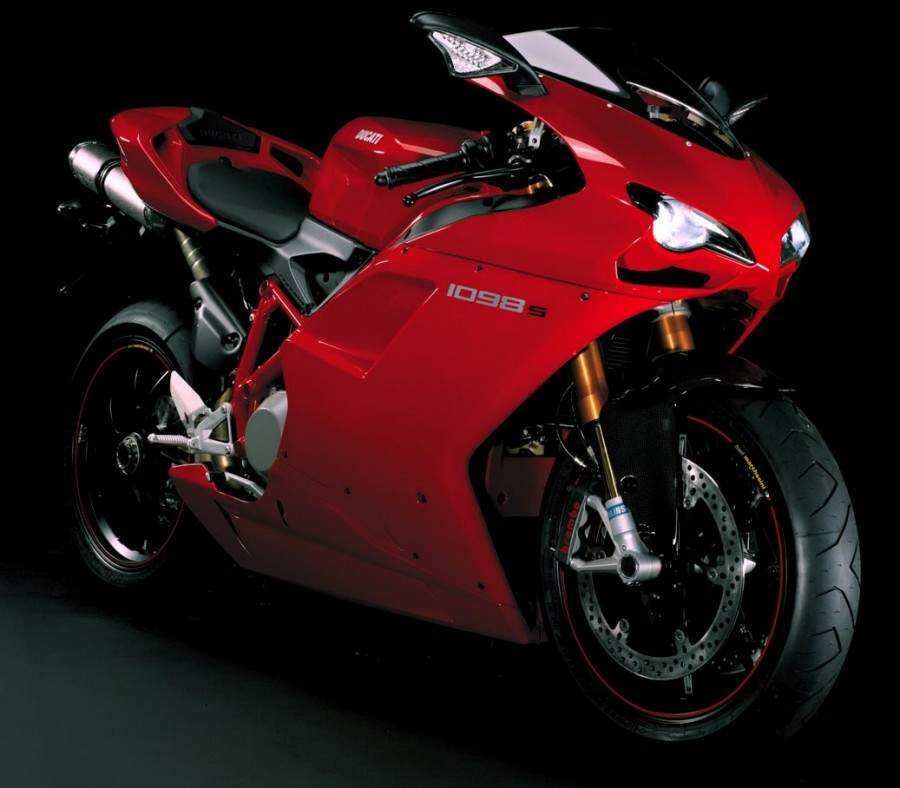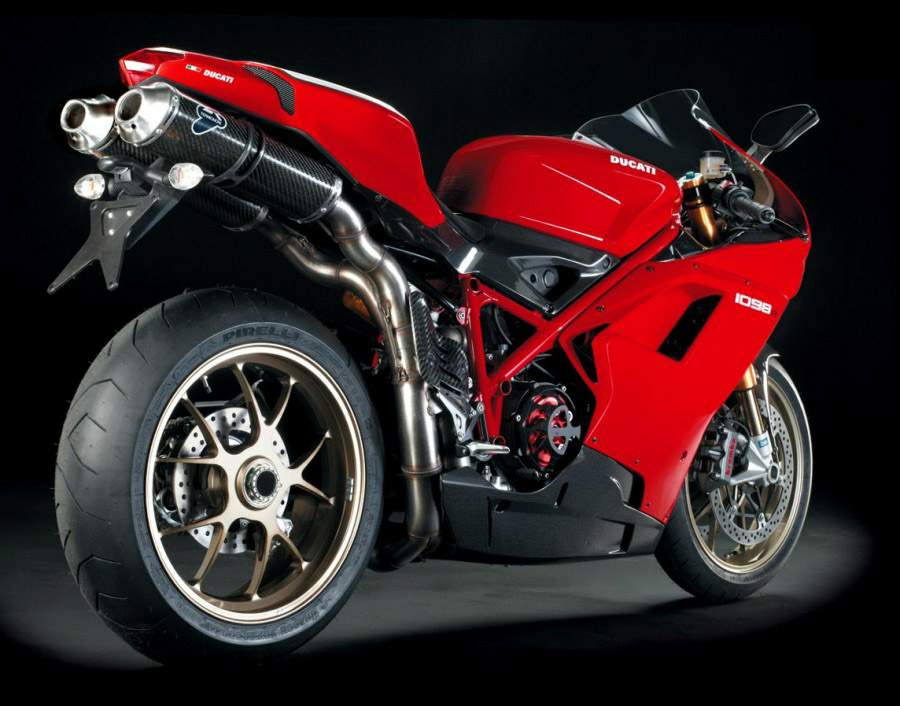
Progressive linkage with fully adjustable Öhlins monoshock with top-out
spring. Aluminium single-sided swingarm, 127mm wheel travel
Front Brakes
2x 330mm discs 4 piston calipers
Rear Brakes
Single 245mm disc 2 piston caliper
Front Tyre
120/70
ZR17
Rear Tyre
190/55
ZR17
Seat Height
840 mm
Dry-Weight
173 kg
381 lbs
Fuel Capacity
15.5 Litres
Standing 0 - 100km
3.1 sec
Standing 0 - 140km
5.1 sec
Standing 0 - 200km
8.1 sec
Standing
¼ Mile
10.9
sec / 213.2 km/h
Standing 1000 m
20.3 sec / 250.0 km/h
Top Speed
273.5 km/h
'S' performance
The 1098 S reduces weight to the max and adds world-class components to an
already record-breaking design. If owning the ultimate is your dream, the
'S' is ready to deliver.
Suspension is of the very highest performance standard. The fully adjustable
43 mm Öhlins FG511 forks, which sport low friction Titanium Nitride-treated
fork sliders, respond effortlessly to every imperfection in the tarmac.
Beyond their advanced engineering solutions, one of the most important
characteristics of Öhlins forks is their ability to communicate the
condition and quality of the tyre-to-road contact patch, a feature that puts
every rider in superior control. The suspension system is completed and
perfectly balanced by using a fully adjustable Öhlins 46PRC rear shock with
a ride enhancing top-out spring, mounted to a single-sided swingarm for
outstanding drive and traction. The Öhlins package is completed with a
control-enhancing adjustable steering damper.
LIGHTWEIGHT PERFORMANCE
The 'S' also sets a new standard for lightweight performance. On any sport
or race bike, the most effective area to reduce weight is its 'unsprung
weight'. These are components like tyres, brakes and wheels. The 1098
addresses this important area by mounting Marchesini forged and machined
wheels, further reducing weight by 1.9 kg (4 lbs). Both front and rear are
super lightweight and their benefit is immediately apparent. The weight
saving is further enhanced with the application of a carbon fibre front
fender and seat fairing cooling ducts.
The 1098 S is also supplied with the Ducati Data Analysis system as standard
equipment. The DDA package supplied with the 'S' version enables the
retrieval of data and analysis of data collected from your previous track
session or road trip. The DDA package includes software for your personal
computer on CD, data retrieval USB key and instructions.
DUCATI DATA ANALYSER (DDA)
The DDA package consists of a real analysis system for data gathered during
rides or track sessions. The kit, normally used only on race bikes, enables
riders to thoroughly analyse the performance of their Ducati and the
effectiveness of their driving style.
The Ducati Data Analyser, which is standard equipment in this model,
automatically records data from numerous channels, including distance
travelled, laps and lap times, throttle opening and engine temperature. In
addition, the DDA automatically calculates engine rpm and vehicle speed data
so as to display gear selection as an additional channel of information. At
the end of a ride or track session, up to 2 MB (approximately 3.5 hours) of
data can be downloaded to your PC.
Data can be analysed in graphic form with options to zoom into detail of
specific sections. For example, dragging a trace along a timeline to reveal
individual values of the above listed channels enables the user to analyse
performance in the same way as data technicians in factory teams.
The DDA package includes PC software, a USB-ready data retrieval card and an
instruction manual.
ENGINEERED BY THE STOPWATCH
The Superbike family for 2008 features two important changes: the
introduction of a mid-engine size version, the light and nimble 848, and an
extreme 'racing' version for all those who demand the maximum performance,
the 1098 R version that will take part in the 2008 World Superbike
Championship.
The priority in every step of the 848 and 1098 development has been
performance first. Every system, every detail and every component has been
studied, pared down to its essence and performance increased to the maximum.
If it didn't make our Superbike lighter, faster or deliver quicker lap
times, it wasn't considered. The result: the 1098 is the most powerful
twin-cylinder motorcycle in the world.
The 848 and 1098 are the lightest, fastest stopping, quickest lapping Ducati
Superbikes in history. For the first time Ducati MotoGP and World Superbike
technology have been combined to create premier sport bikes. The results are
stunning.
DESIGNED BY THE RACETRACK
The look and stance of the 848 and 1098 were designed by the combination of
race track technology, track-derived components and Ducati heritage. Their
striking aerodynamic shape naturally embraces a riding position, configured
by our racers and test riders for optimum speed and agility. The racing
spirit takes form.
Cycle Review
Ducati 1098S VS. KTM RC8 1190 - Same Difference
From the November, 2008 issue of Motorcyclist
By Aaron Frank
Photography by Adam Campbell, Brandon Bones
Is The Austrian Upstart Ready To Take On Italy's Best?
Our First Ride report in June called the RC8 "the biggest threat to desmodromic
domination in decades"-a reference to the inevitable rivalry between KTM's
all-new superbike and Ducati's potent 1098, the current standard-bearer of
sporting V-twin performance. There's no shortage of similarities between these
two machines. Both come from determined, racing-oriented European manufacturers.
Both slot big-bore V-twins into lightweight steel-trellis frames. Both feature
top-quality suspension components-il on the Ducati, WP for the KTM. And both
bristle with paddock-bred bling such as Marchesini wheels and Brembo brakes. A
cursory spec sheet scan begs the obvious question: How do these two bikes stack
up?
We didn't waste any time finding out. As soon as we got our greasy palms on an
RC8 (one of only 10 in the USA at the time), we lined up a 1098 for a proper
comparison. At Ducati's insistence, we paired the RC8 with the upgraded 1098S,
which features lighter Marchesini forged wheels, Ohlins suspension and steering
damper and some choice carbon-fiber bits. Hmm, maybe Bologna is nervous? To be
fair, though, the $19,498 RC8 is much closer in price to the 1098S ($19,995)
than the base-model 1098 ($15,995).
KTM's WP shock offers unparalleled... read full caption
KTM's WP shock offers unparalleled accessibility for varying spring preload.
Eccentric fitting in linkage allows 20mm of ride-height adjustment.For all their
similarities, these two twins couldn't look more different. Designed by Pierre
Terblanche protg Giandrea Fabbro, the Ducati's shape is organic, like a
two-wheeled Tiger Shark. The KTM, drawn by Salzburg's Design Studio KISKA, is
all edges and angles, like an F-117 Nighthawk. The finishes on the 1098S-woven
carbon-fiber, gold hlins hardware and "murdered-out" (photographer Adam
Campbell's description) metallic black paint-are pure luxury. Half the RC8's
bodywork (tank, tail and fairing lowers) is molded in color, dirtbike-style,
lending a Tonka-like plasticity. It's not cheap-looking, though, and gives the
bike a futuristic appeal. LED turn signals and tail lights, along with a modern
under-engine muffler, further the KTM's present-tense style. Conventional lenses
and an undertail exhaust make the Ducati look quaint by comparison.
These two bikes come from different ergonomic
planets as well. Like all Ducati Superbikes, the 1098's riding position is
either unforgiving or unforgivable, depending on your degree of flexibility. The
face-down, ass-up riding posture makes zero comfort concessions, with a high,
forward seating position that preloads the front end for improved handling but
works your upper body on long, straight stretches. Suspension settings stiff
enough to blur your vision provide little relief.
Molded-in-color plastic panels... read full caption
Molded-in-color plastic panels contrast with metallic-painted body parts on the
KTM. Built-in tank sliders are a value-added touch.
Info-rich or information overload?... read full caption
Info-rich or information overload? KTM's multi-function display offers "race"
(lap timer) or "road" (tripmeter) modes. Mirrors are great until high-rpm vibes
scramble the image.
The RC8 uses standard-issue... read full caption
The RC8 uses standard-issue cast, five-spoke Marchesini wheels. Tires on both
bikes are Pirelli's superb Dragon Supercorsa Pros.
Ergonomically speaking, the KTM is more adjustable than an Aeron chair. Clip-on
bars provide a few inches of vertical variation, and the footpegs offer high and
low positions as well. The brake and shift lever toe pieces are three-position
adjustable, and the hydraulic clutch and front brake levers offer five settings.
The RC8's saddle is very supportive and, with the footpegs set low and the
handlebars raised high, the bike provides a level of comfort superior to any
competitive sportbike.
The Ducati's lusty, short-stroke, desmo-valved, 1099cc V-Twin has a ravenous
appetite for revs that makes it thrilling to ride at any speed. Cavernous,
elliptical-shaped 60mm throttle bodies suck air with an audible roar, and the
barely-legal 2-1-2 exhaust provides auditory stimulation that will only
encourage your anti-social impulses.
The second-generation LC8 motor powering the KTM
is every bit the Ducati's technological equal. A dry-sump lubrication system
with integrated oil tank saves weight-at 141 pounds, this compact, 1148cc twin
actually weighs less than the 999cc version that powers KTM's Adventure,
Supermoto and Super Duke models. High-strength, lightweight connecting rods and
flat-top pistons reduce internal reciprocating mass, while 52mm throttle bodies
feed more compact cylinder heads. The exhaust system consists of a large-volume,
mass-centralizing under-engine muffler that manages Euro 3 compliance without
sounding completely choked.
Spinning the drum on the dyno reveals some surprising similarities-and
differences. Peak power is nearly identical, the Ducati putting 136.2 bhp to the
rear wheel compared to the KTM's 134.9. But at lower revs the two power profiles
are wildly divergent. The 1098S lords 4.4 lbs.-ft. of torque over the RC8 at
3500 rpm, then stumbles into a 2000-rpm-wide hole that gives the latter a
significant midrange advantage (11.2 lbs.-ft. at 5K)-right where you want power
on the street. The Ducati reclaims the advantage at 6K, however, and holds the
upper hand all the way to the dark end of the digital bar tachs.
The Ducati storms down the road with ferocious authority. Massive thrust arrives
the instant you let out the clutch, and the quicker-revving, shorter-stroke
motor blows through that midrange hole so fast you barely notice it before the
impressive top-end rush has you scrambling for the next gear. The
smooth-building KTM offers a more civilized experience. Unlike the Ducati, which
wheelies everywhere in the first three gears, an extra-long swingarm and
exceptional forward weight bias (a claimed 54 percent) conspire to keep the
KTM's front end planted. Significantly taller gearing (4.14:1 overall drive
ratio, compared to 4.66:1 for the 1098S) calms things even more, making the KTM
feel less lively on the gas.
Brian Catterson
Off The Record
I first saw the RC8 at the KTM factory shortly after riding the prototype Super
Duke. That should give you an idea how long this thing has been gestating. What
impressed me about KTM's R&D team was how much effort they'd expended evaluating
the competition. Parked in the shop were examples of all the Super Duke's
would-be competitors, each accompanied by a thick notebook chock-full of data.
All manufacturers do this, of course, but it was especially critical for KTM,
which was then developing its first proper streetbike. No doubt they did the
same for the RC8, which explains why it came so close to unseating the 1098S.
Not since Aprilia and Honda made a run at Ducati has there been another
competitive twin in World Superbike. Here's betting Mattighofen gives Bologna a
run for its money.
The 1098S simply feels more explosive everywhere, especially at the racetrack.
We took this twosome to a Fastrack Riders track day at Auto Club Speedway in
Fontana, where Catterson threw down a best lap of 1:37.586 on the 1098S,
compared to a 1:38.998 for the RC8. That's slow compared to the 1:29s the
winning A Superstock riders turned in that weekend's WERA West races, but either
bike would have handily won in Heavyweight Twins. Superior acceleration and a
quick-shifting, close-ratio gearbox made it easier to exploit the Ducati's
high-rpm output-especially on the superspeedway's banked front straight.
Speedometers are never 100 percent accurate, but the 1098's digital display
flashed 168 mph approaching the Turn One chicane compared to 151 mph on the RC8.
You could feel that difference from the saddle.
Turn your attention away from the throttle, however, and some advantage shifts
back toward the KTM. Tighter portions of the track-especially the
left-right-left transition entering the infield-were unquestionably easier to
negotiate on the RC8. The KTM's steering is exceptionally light, requiring
little input to initiate turns. The RC8 remains impressively neutral when leaned
over, and is utterly indifferent to brake inputs or pavement imperfections.
Contrast this to the more top-heavy Ducati, which has a tendency to fall into
turns (exacerbated by the need for strong initial steering input) and resist
turning under braking. Both bikes use Brembo's stunningly strong radial-mount
Monobloc calipers, so braking behavior is especially important. The Ducati's
brakes feel a bit sharper on initial application, though, perhaps due to its
larger-diameter 330mm rotors.
Ohlins, Brembo, Marchesini... read full caption
Ohlins, Brembo, Marchesini ... the chassis spec is first-rate on Ducati's
upgraded 1098S.
1098S dash is straight out... read full caption
1098S dash is straight out of MotoGP. Ducati's Data Analysis System is standard
equipment, letting owners download performance figures after a ride.
The 1098S is fitted with lighter,... read full caption
The 1098S is fitted with lighter, forged-then-machined 10-spoke Marchesini
hoops. Unlike its $40K sibling, the 1098R, there are no provisions for traction
control.
On twisty mountain roads the KTM's effortless steering and supremely balanced
chassis are big confidence boosters, letting you make last-minute line
corrections and steamroll potholes and sealer strips without worry. The plush WP
suspension strokes predictably through the full range of travel without
bottoming hard, increasing your confidence even more. It's too bad, then, that
the fuel injection tends to hunt at constant throttle openings. This was
especially noticeable in long, constant-radius corners, where uneven speed,
coupled with the RC8's sensitive steering, could cause the bike to wander. It
likes to be ridden on the gas.
In stock trim, the Ducati's up-spec Ohlins suspension is too stiff for the
street-you can't tell what's going on with the chassis until you up the pace, at
which point you'll be rewarded with the supreme wheel control and telegraph-like
feedback we've come to associate with the Swedish suspenders. This can be a
challenge on bumpy, dirty public roadways, where it takes considerable faith to
ride the bike hard enough to make it work.
Though stiff and ergonomically unforgiving, the 1098S is functionally tight as a
drum. Throttle response is immediate and flawless at any rpm and for any
duration, thanks to twin injectors that never choke or stumble. The inherently
better-balanced 90-degree engine delivers less distracting (and fatiguing)
vibration than the 75-degree KTM; despite twin balance shafts, a fair amount of
vibration passes through the RC8's headstock and into the bars above 7000 rpm.
The Ducati's gearbox is also better, as precise and predictable as a Swiss
timepiece. The KTM's tranny has a long throw between gears, which requires a
firm tug on the lever-more so after we raised the footpegs and adjusted the
shift linkage to match at the track. A few times it even popped out of top gear.
Looking purely at performance numbers, the Ducati remains the bike to beat-but
just barely. It's remarkable how close KTM has come to upsetting the status quo
with its first pure sportbike. Not only does the 1098S outrun the RC8
numbers-wise, there's also the issue of price. Though the RC8 and 1098S are just
$497 apart, at $15,995 the standard-model 1098 is fully $3504 less expensive.
Since it utilizes the exact same engine as the S-model, the outright performance
should be quite close, tipping the scale even more in Ducati's favor.
If you'd prefer to avoid joining the ranks of the Ducatisti, though, you're not
doing yourself a disservice by choosing the KTM. The RC8 is a more flexible and
forgiving streetbike than the 1098, and with shorter gearing it would likely
accelerate as well, too. Act quickly, though: KTM will bring just 50
limited-edition 20081/2-model RC8s into the states this year-each distinguished
with a serialized plaque-and most of those are pre-sold. Let's hope the company
imports more-many more-in '09, because this Italian-Austrian battle has just
begun.
Aaron Frank
Off The Record
Ducati's 1098S is as close as you can get to race-ready performance on the
showroom floor. This is great, provided you are prepared to ride at race pace
all the time. If not, you're more likely to find yourself frustrated by a bike
that is terribly uncomfortable, slow to change direction and severely oversprung
for a lightweight like me. I'm more comfortable lately to ride around at seven
or eight-tenths and live to rail another day. For this I find the kinder,
gentler KTM RC8 a much more suitable mount. The power output is essentially
equal to the Ducati, but with a more neutral, responsive chassis and more
compliant suspension, it's a less demanding, more enjoyable ride. This is a
fairly remarkable first effort from KTM, and one I wouldn't hesitate to park in
my garage.
2008 Ducati 1098S | Price: $19,995
Hard Parts
Engine
Ducati's Testastretta EVOluzione engine motivates the 1098S, topped with
MotoGP-derived elliptical throttle bodies said to flow 30 percent more air than
conventional round bodies. Oversquare cylinder dimensions make the motor rev
quicker, and a narrow valve angle provides a straighter shot into reshaped
combustion chambers. Magnesium valve covers reduce weight.
Chassis
Super-light, forged and machined Marchesini racing wheels drop 4 pounds of
unsprung weight compared to the base-model 1098. The latest version of Ducati's
signature single-sided swingarm, composed of stiffer castings at the pivot,
wheel hub and suspension link connected with fabricated aluminum sections, is
lighter and stronger than before.
Suspension
Ohlins FG511 fork is fully adjustable with ti-nitride coated sliders that
minimize stiction to communicate even the most subtle change in road conditions
to the rider. The 46PRC shock features a top-out spring to enhance ride quality.
Rear ride height is adjustable independent of spring preload.
Brakes
Brembo's mighty M4-34 Monobloc calipers, machined from a single piece of alloy
for higher rigidity and greater distortion resistance, clamp down on 330mm
rotors mounted to the front wheel. A radial-pump master cylinder offers better
feedback with less lever travel, for improved modulation.
Tech Spec
Engine type: l-c 90-deg. V-twin Rear brake: Single Brembo two-piston caliper,
245mm disc Corrected 1/4-mile: 10.06 sec. @ 140.8 mph
Valve train: DOHC, 4v desmo Front tire: 120/70ZR-17 Pirelli Dragon Supercorsa
Pro Top-gear roll-on 60-80 mph: 2.96 sec.
Displacement: 1099cc Rear tire: 190/55ZR-17 Pirelli Dragon Supercorsa Pro Fuel
mileage (high/low/avg.): 36/33/34 mpg
Bore x stroke: 104.0 x 64.7mm Rake/trail: 24.5/3.8 in. Colors: Red, black
Compression: 12.5:1 Seat height: 32.2 in. Availability: Now
Fuel system: Marelli EFI Wheelbase: 56.3 in. Warranty: 24 mo./unlimited mi.
Clutch: Dry, multi-plate Fuel capacity: 4.1 gal. Contact:
Ducati North America
10433 Bandley Dr.
Cupertino, CA 95014
408.253.0499
www.ducatiusa.com
Transmission: 6-speed Weight (tank full/empty): 438/413 lbs.
Frame: Tubular-steel trellis Measured horsepower: 136.2 bhp @ 9500 rpm
Front suspension: 43mm Ohlins inverted cartridge fork, adjustable for spring
preload, compression and rebound damping Measured torque: 79.7 lb.-ft. @ 8000
rpm
Rear suspension: Single Ohlins shock, adjustable for spring preload, compression
and rebound damping
Front brake: Dual Brembo four-piston radial calipers, 330mm discs
2008 KTM RC8 1190 | Price: $19,498
Hard parts
Engine
A bigger bore (103mm) and longer stroke (69 mm) add up to 1148cc displacement,
but thanks to right-sizing, KTM's latest LC8 engine is lighter and more compact
than the 999cc version that powers the firm's other twins. Double overhead cams
are chain-driven and cam followers activate eight valves, for a simple, compact
cylinder head design.
Chassis
The RC8's trellis frame, welded in the company's Mattighofen facility, is made
from chromoly steel and weighs less than 17 pounds. The swingarm is constructed
from a mix of cast parts and sheet-metal sections to save weight and increase
strength. The subframe pivots to adjust seat height by .8 of an inch.
Suspension
Suspension comes from long-time KTM partner WP. The fork offers 10mm of preload
adjustment, 32 clicks of compression damping and 28 clicks of rebound. An
eccentric fitting in the rear suspension linkage permits a 20mm ride-height
adjustment. Shock access, for adjusting preload, is unparalleled.
Brakes
More of the same Monobloc action on the KTM, with a pair of radial-mount Brembos
up front clamping down on 10-button, 320mm rotors. Each caliper contains four
separate brake pads (one per piston) for improved cooling. The rear brake is a
two-piston caliper, also made by Brembo, matched to a 220mm disc.
Tech Spec
Engine type: l-c 75-deg. V-twin Rear brake: Single Brembo two-piston caliper,
220mm disc Corrected 1/4-mile: 10.27 sec. @ 138.1 mph
Valve train: DOHC, 4v Front tire: 120/70ZR-17 Pirelli Dragon Supercorsa Pro
Top-gear roll-on 60-80 mph: 3.05 sec.
Displacement: 1148cc Rear tire: 190/55ZR-17 Pirelli Dragon Supercorsa Pro Fuel
mileage (high/low/avg.): 40/35/36 mpg
Bore x stroke: 103.0 x 69.0mm Rake/trail: 23.3/3.5-3.6 in. Colors: Orange/black,
white
Compression: 12.5:1 Seat height: 31.7-32.5 in. Availability: Now
Fuel system: Keihin EFI Wheelbase: 56.3 in. Warranty: 36 mo./36,000 mi.
Clutch: Wet, multi-plate slipper Fuel capacity: 4.4 gal. Contact:
KTM North America, Inc.
1119 Milan Ave.
Amherst, OH 44001
440.985.3553
www.ktmusa.com
Transmission: 6-speed Weight (tank full/empty): 441/416 lbs.
Frame: Tubular-steel trellis Measured horsepower: 134.9 bhp @ 10,250 rpm
Front suspension: 43mm WP inverted cartridge fork, adjustable for spring
preload, compression and rebound damping Measured torque: 75.4 lb.-ft. @ 7000
rpm
Rear suspension: Single WP shock, adjustable for spring preload, high/low-speed
compression and rebound damping
Front brake: Dual Brembo four-piston radial calipers, 320mm discs
Source Cycle World
NOTE: Some of the photos on
Motorcycle Specs are owned by somebody. If you see any of your
photos, you can let me know so that I can acknowledge it, or if
you object to it, I can remove it altogether. If any copyright
holder objects to their articles being placed on Motorcycle
Specs, it will be removed upon request. Any correction or more
info on these bikes will kindly beappreciated
Contact MePrivacy
Policy
Website Stats