|
|

|
|
|
|
Classic Bikes
Custom Bikes
Individual
Racing Bikes AJP
AJS
Aprilia
Ariel
Avinton / Wakan
Bajaj
Benelli
Beta
Bimota
BMW
Brough Superior
BRP Cam-Am
BSA
Buell / EBR
Bultaco
Cagiva
Campagna
CCM
CF Moto
Combat Motors
Derbi
Deus
Ducati
Excelsior
GASGAS
Ghezzi Brian
Gilera
GIMA
Harley Davidson
Hero
Highland
Honda
Horex
Husaberg
Husqvarna
Hyosung
Indian
Jawa
Kawasaki
KTM
KYMCO
Laverda
Lazareth
Magni
Maico
Mash
Matchless
Mondial
Moto Guzzi
Moto Morini
MV Agusta
MZ / MuZ
NCR
Norton
NSU
Paton
Peugeot
Piaggio
Revival Cycles
Roland Sands
Royal Enfield
Sachs
Sherco
Sunbeam
Suzuki
SWM
SYM
Triumph
TVS
Ural
Velocette
Vespa
Victory
Vincent
VOR
Voxan
Vyrus
Walt Siegl
Walz
Wrenchmonkees
Wunderlich
XTR / Radical
Yamaha
Zero
Video
Technical
Complete Manufacturer List
|
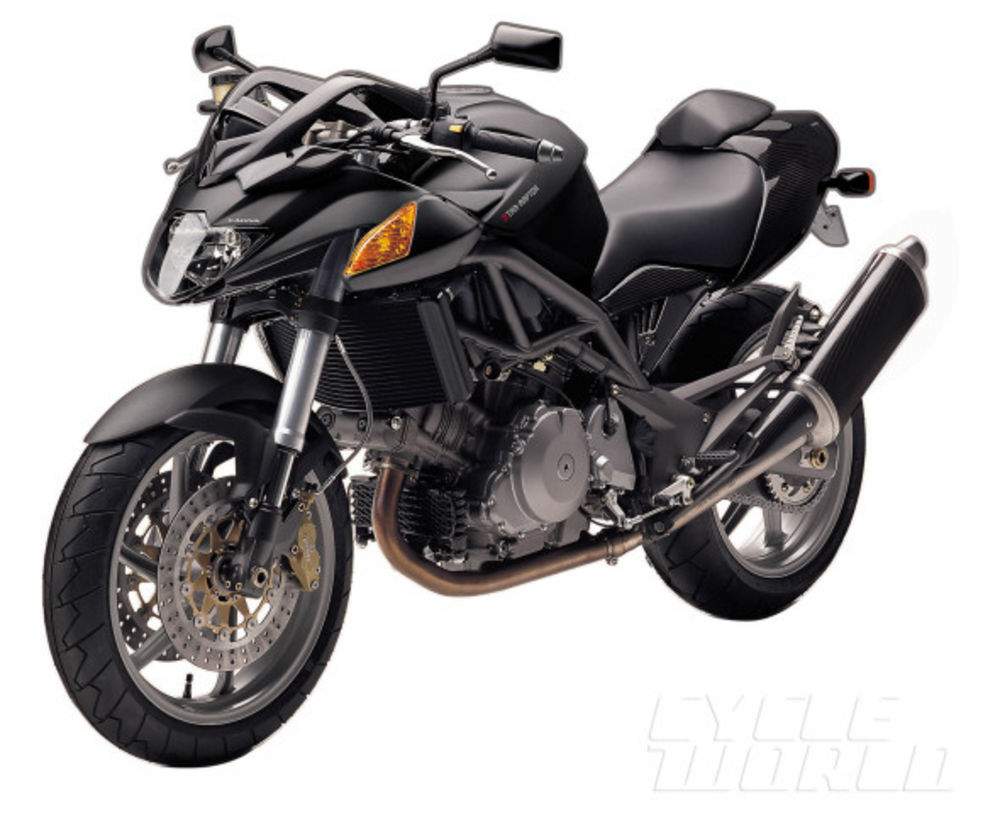
Cagiva Xtra Raptor 1000
fork and damper completely adjustable. You can lose us in 90 clicks of regulation (50 in extension, 40 in compression) and this solo for the damper (branded Sachs) because also the fork (Marzocchi) to stems upset by 43 mms it is completely adjustable.
The damper has the longest stem of 5 mms and,
together to the magazine geometry of the leveraggis that operates it, is the
person responsible of the back raised again of 30 mms in comparison to the
Raptor "normal". In poor words, it means to have greater earth light and any
interference with the asphalt, also when the folds are made exaggerated… But
it is not everything: with this solution the distribution of the weights is
changed, also that from the "tourist" 46% - 54% (anterior-back) it is passed
to a more weapon 50-50.
To lend a hand also arrives a damper of placed steering gear really under the adunco beak
If looks defined character,
then this is a bike that could probably bite your leg off if you got too close
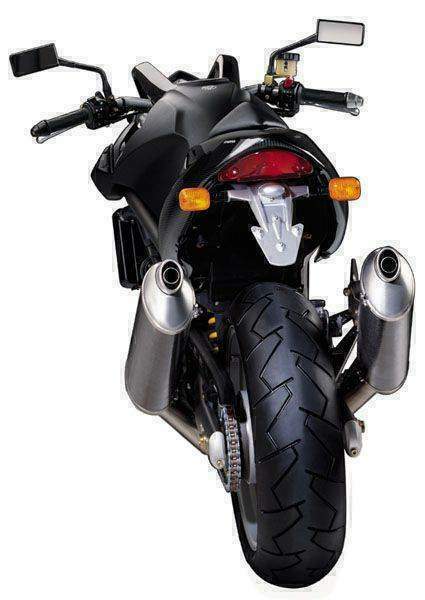
to it. Like a leashed Doberman Pinscher, the Cagiva Xtra Raptor
exudes aggression, from its beak-like headlamp at the front, all the way
through to the twin carbon-clad end-cans at the back. The dark matt paint
finish, described as "Bat Black" in the brochure, only adds to the air of
menace that this bike projects. Like stealth fighter parked up at the end of a
runway, the Xtra Raptor looks like it means business. And there's some nice
little design touches, like the bike's name machined into the carbon cans, and
the rows of three "teeth" that protect the cans from the pillions heels. Not
that riding pillion on this bike is that desirable. Remove the seat hump and
you'll find that perch is a little on the small side and there's only a strap
to hang onto. A quick trip down the road is about all it's good for.
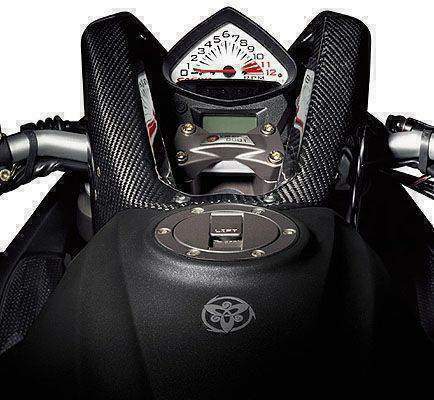
As well as attitude, the Xtra Raptor literally bristles with carbon fibre. Those strange trademark tubular horns that connect the headlamp fairing to the tank, the side panels below the seat, the heel protectors on the exhaust pipes, the single seat hump and the number plate hanger are all made from carbon fibre. It's the real thing too - not some cheap look-a-like plastic. This is one predatory looking machine. Okay, so you've designed a bike that looks like something out of Mad Max without the furry bits, but you still need an engine to make it go. Moving from A to B is not going to be enough here. This is a bike that has to project itself, so a transverse four or triple just won't cut the mustard. We need an engine with a character to match the rest of the bike, a V-twin to go with the bike's lean 'n' mean looks, an engine that achieved almost legendary status when it first appeared some years ago, although not always for the right reasons. That's right, we'll use the Suzuki TL1000S motor, and it'll be the full power version, not one of those de-rated types with edge taken off the power delivery. Pull in the clutch, thumb the starter button and the engine barks into life on the fast idle, settling down to a steady tickover as everything warms up. Even the exhaust note is in character, and sitting in a traffic queue it sounds like those carbon cans are firing bullets into the radiators of the cars behind. You can blip the throttle to increase the rate of fire! The instruments are another stroke of the designer's pen, although the triangular white-faced rev counter which looks strange at first, is surprisingly easy to read on the move, as is the lcd panel below it. This shows mph and total miles traveled and has two trips for recording individual journeys. Less useful were the "optional" mirrors fitted to the test bike. These were far more useful for hanging things on than for seeing what was on the road behind you, and were of a size and type normally associated with single-seater racing cars. They also needed an 11mm spanner to adjust them, and very few people keep one to hand when they're out riding! The cable-operated clutch is light and positive but with a fairly sharp take-up, and who could forget the on/off throttle action of the of the original 1000S engine. Cagiva have calmed things down a bit for the Raptor version, but that switch-like throttle control is still lurking down there somewhere in the engine management system. This meant my first couple of starts from rest were a bit like rocket launches, but you soon get the technique for getting the bike smoothly off the line. There's little danger of stalling the motor with too few revs, as that TL1000S engine is a real "torque monster". In fact that padded seat hump can be a positive benefit to stop you sailing off the back of the bike when you really give it some. Another good reason for not carrying a pillion - if you needed one! On the move and the riding position is a
little strange at first. The wide bars hint at relaxed upright stance, but the
high(ish) footpegs tend to push you into more of a sportsbike riding position
and you'd really then want the grips to be narrower and closer to you. While
this wasn't uncomfortable, it didn't feel particularly natural and my arms were
kept a lot straighter than I would have liked. What was uncomfortable however
was the seat. Now I'm not known for having a bony backside, but after the first
70 miles the seat had all the comfort characteristics of a tree trunk, and I
just had to take a break. Subsequent journeys increased the range of my bum, but
when the low fuel warning light came on at around 100 miles, I have to say that
every time I was glad to get off and restore the movement to my legs. Although
the tank capacity isn't massive at a fraction over 15 Litres
The Xtra Raptor has massive 43mm USD forks at the front and a progressive monoshock at the rear, which on their standard settings give a ride that's on the hard side of firm. This may be alright for race tracks, but for the variable quality British roads it's not too pleasant. To calm things down I backed off the damping all round and this gave a much better ride, although too frequently, encountering bumps mid-corner induced sudden throttle position changes and some lively moments. It felt more as through the spring rates were a little on the high side, although we didn't have either the time or opportunity to take measurements or make changes. Having said all that though, the ride was stable and the bike went where you put it. The wide bars were good here for tipping the bike into corners, although the riding position didn't encourage hanging off too much. As you would expect from a Suzuki box, gear selection was positive and there were no false neutrals, although the lever needed a firm action. The ratios were well spread and suited to the power delivery of the engine, and it was always easy to find neutral at rest. Not so easy to find was the side stand, which was very stiff and difficult to operate and looked as though it was made out of a left over piece of chassis tubing. A minor niggle I know. A little more worrying was the fact that a lot of the plated fasteners and fittings on the bike were already showing signs of corrosion after six months. However this bike was a demonstrator, and may not have had the same degree of care bestowed upon it as it would have had if it was privately owned. While that wonderful TL1000S engine will launch you out of corners like a missile, almost irrespective of which gear you're in, when it comes to stopping, the four-pot Brembos at the front do an equally impressive job. They have a smooth progressive action and one or two fingers at the most are all you need to haul the bike down from highly illegal speeds, aided in no small measure by the massive amount of engine braking from that V-twin. Even the back brake was quite effective and had a surprising amount of feel to it. Cagiva quote a top speed of around 140 mph for the Xtra Raptor, which is probably about right although I was never in a position to prove or disprove it. However I can say that after about 5 minutes at a three-figure speed, I felt that my neck had stretched by a good two inches and my head was about to disappear off down the road behind me. Maybe this is a bike for speedy rugby prop forwards? Backing off to around 85-90 mph was much more comfortable and it seems that the beaky headlamp fairing actually helps deflect some of the air past the rider. As well as weekend blasts with your mates or trips to a local watering hole (orange juice and lemonade please), the Xtra Raptor also makes a fine means of urban transport. The riding position gives a good view over the traffic and the wide bars and good steering lock means that it's easy to manoeuvre through the grid locked cars. The torque from the TL1000S engine make gear changes an irrelevance, and the lower speeds mean that other people can see how aggressive the bike actually looks. You never know, you could even frighten one or two car drivers into submission simply by them looking in their mirrors (I've heard they do that occasionally). But let's face facts, in spite of the billing that Cagiva gives the Xtra Raptor, this is not a sportsbike in the way that we understand such a term when uttered by the likes of Ducati or the Japanese Big Four. We're not talking about a razor-sharp handling trackday tool, a bike that falls into corners just by thinking about them. What we have in the Cagiva Xtra Raptor is a bike that has to be ridden in a sporty manner; a bike that needs the rider to work at getting it from A to B, a bike that needs a lot of the right inputs, but then rewards the rider with a big grin because you've made the bike do what you wanted it to do and it all came together beautifully. Brief Second Opinion I only got to ride the Xtra Raptor for about 10 miles when I met Dick for the photo shoot. First impressions were brilliant - I've rarely seen a bike with such road presence. It looks fantastic, the detailing is wonderful and the noise is pretty good as well. OK, so it's crying out to be ridden in urban camouflage gear with a matt black Bandit helmet, but hey - it works fine with one piece leathers and an Arai as well, so that's OK. The riding position is interesting, with fairly rearset pegs but high bars. Which should mean that with a 1000cc vee twin below you the front wheel would spend more time aloft than steering. Not so, though, because although there was certainly plenty of urge to indulge in such silliness should you wish, it all remains extremely controllable. But the combineation of bars and pegs didn't feel natural, and personally I would be happier going with the clip-ons fitted to the race bike run by importers Three Cross. Handling is exactly what you'd expect from an Italian thoroughbred. Taut, accurate and stable if needing a firm hand to get turning. The brakes are excellent and everything comes nicely to hand. Except the mirrors, which are roughly the size and shape of a 10-pack of cigarettes. And not king-size, either. Overall? Great looks, great sound, brilliant presence. Definitely one for the "if money was no object" collection... Source Dick Henneman
|
|
|
Any corrections or more information on these motorcycles will be kindly appreciated. |