|
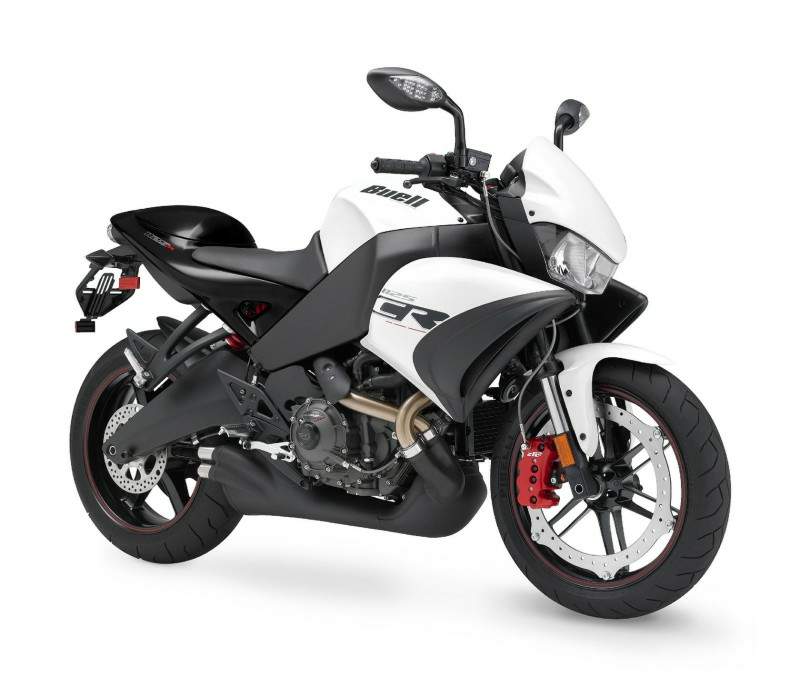
Buell 1125CR

|
Make Model |
Buell 1125CR |
|
Year |
2010 |
|
Engine |
Liquid cooled, four stroke, r72° V-Twin, |
|
Capacity |
1125 |
|
Bore x Stroke |
103 x 67.5 mm |
|
Compression Ratio |
12.3:1 |
|
Induction |
Dual 61mm Downdraft Throttle Bodies, DDFI III
Fuel Injection System |
|
Ignition /
Starting |
- / electric |
|
Max Power |
146 hp @ 9800 rpm |
|
Max Torque |
111 Nm @ 9000 rpm |
|
Transmission /
Drive |
6 Speed / belt |
|
Gear Ratio |
1st 2.462 / 2nd 1.75 /
3rd 1.381 / 4th 1.174 / 5th 1.042 / 6th
0.96 |
|
Frame |
Aluminium frame with fuel in frame. |
|
Front Suspension |
47mm Showa inverted forks, adjustable
compression damping. rebound damping and spring preload. 120mm wheel travel. |
|
Rear Suspension |
Showa® coil over monoshock, adjustable
compression damping. rebound damping and spring preload. 12umm wheel travel. |
|
Front Brakes |
ZTL type brake, 6-piston, fixed caliper, 375 mm
single-sided, inside out, stainless steel, floating rotor |
|
Rear Brakes |
Single 240mm disc 2 piston floating caliper |
|
Front Tyre |
120/70 ZR17 |
|
Rear Tyre |
180/55 ZR17 |
|
Seat Height |
775 mm /
30.5
in |
|
Dry-Weight |
168 kg / 375 lb. |
|
Fuel Capacity |
21.2 Litres / 5.3 gal |
|
Consumption average |
18.3 km/lit |
|
Standing
¼ Mile |
11.0 sec |
|
Top Speed |
242.6 km/h |
|
Reviews |
Motorcycle.com /
Motor Revue
/ Motorcycle /
Motorcycle USA /
Motorcycle Daily /
Motocyclist |
As a modern Café racer, the Buell 1125CR model
combines the 146-hp, liquid-cooled Helicon 1125 cc V-Twin engine with the Buell
Intuitive Response Chassis (IRC) to create a bad attitude bike backed up with
exceptional performance. A new upright tapered aluminum handlebar adds comfort
while transforming the ride from sport to pure streetfighter. Final-drive
gearing optimizes acceleration for the street, and an upgraded front master
cylinder improves brake feel. New graphics, bodywork colors, blacked-out
components, LED taillight, rear turn signals, and a flycut ZTL2 logo on the
brake caliper deliver style. A new engine cover sightglass for oil checks and a
battery tender plug pre-wired into the wiring harness add convenience. The
1125CR model is now available in a new Artic White/Midnight Black color
combination, as well as Midnight Black and Racing Red.
Model Highlights
New Tapered aluminum streetfighter
handlebar
New Polished stainless steel headers
New Master cylinder piston seals for improved brake feel
New Engine cover sight glass for convenient oil-level checks
New Pre-wired battery tender harness
New Designer Black wheels with red pinstripe
New LED taillight
New Clear-lens rear turn signals
New Bodywork graphics and fly cut brake logos
New Arctic White/Midnight Black color combination
New Battery tender plug
• Buell® ZTL2™ four-pad, eight-piston front brake
• Two-piston rear brake caliper mounted directly to inner swingarm
• Brushed stainless steel exhaust outlets
• LED front turn signals integrated with mirrors
• Digital lap timer and gear indicator
• Minimalist flyscreen with integrated head lights
• Removable tail cowl over passenger seat
• Versatile riding position with relaxed footpegs and a short reach to the bars
Key Features
As Erik Buell’s vision of a modern
day café racer, the Buell® 1125CR blends class-leading performance with sinister
styling and a wicked attitude to push the boundaries of the streetfighter
category.
Buell Lightning models and the new 1125CR™ are at the core of what Buell is all
about – pure performance with a broad, seamless power delivery in a stripped
down, raw and aggressive package.
Each Buell model is designed utilizing the Buell Trilogy of Technology™ –
chassis rigidity, centralized mass, and low unsprung weight – to produce a
motorcycle which responds instantly to rider input.
• Buell Helicon® 1125cc liquid-cooled fourstroke, 72-degree V-Twin engine with
DDFI 3 Electronic Fuel Injection ECM
• Compact oblique stacked six-speed transmission configuration
• Ram-air pressurized air box
• Goodyear® Hibrex® final drive belt with Flexten Plus technology with a
constant-tension pulley for smoother on/off throttle transitions
• Underslung muffler with Helmholtz chamber
• Twin side-mount radiators with outer covers designed to absorb impact
• HVA (Hydraulic Vacuum Assist) clutch with slipper action
• 6-spoke, cast aluminum wheels
• Pirelli Diablo Corsa III tires
• Steel braided brake lines
• Fully adjustable 47 mm Showa inverted fork
• Fully adjustable Showa rear shock absorber
• Fuel-in Frame Intuitive Response Chassis
• Rigid cast-aluminum swingarm
• Adjustable hand and foot controls

Buell 1125CR vs BMW K 1300R
The technology that’s gone into these two
bikes is as unconventional as their styling. The 176bhp K1300R uses shaft drive,
the 146bhp 1125CR uses belt drive. The BMW uses Duolever front suspension, which
you won’t find on any other bike, while the Buell’s perimeter disc braking
system at the front wheel entails the use of a single disc – unlike all other
large-displacement sportsbikes, which use twin disc set-ups at the front.
The BMW is the better bike for riding in the city, thanks to its anti-lock
brakes (ABS) and optional traction control – things which provide a lot of
reassurance during hard braking and acceleration. The riding position is pretty
comfortable too, though your shin will often hit the BMW’s engine casing on the
right hand side, when you put your feet down while coming to a complete stop.
Riding the Buell in the city gets tiring within a few kilometres – the high
footpegs, and the shape and the positioning of the handlebar sees to that. But
while it affects low speed comfort, the 1125CR’s sports-oriented riding position
is perfect for high speed cornering.
Another thing that goes against the Buell is its brakes, which work in a rather
abrupt fashion. Initially, the brakes don’t seem powerful enough at all and
then, when they suddenly bite, they can upset the bike somewhat.
Developed by Rotax, the Buell’s v-twin is one of the most pleasant twin-cylinder
engines current available in the market. Low-rpm torque delivery makes the bike
very rideable at low speeds and the linear power delivery means the bike picks
up speed smoothly and consistently.
The BMW’s four-cylinder engine is also much improved over its predecessor – it
feels significantly more powerful, the roughness has disappeared and power
delivery has been smoothened out very well. On the highway, the K1300R offers
better wind protection than the 1125CR and feels more planted, more stable,
while the Buell feels more nimble and responsive.
When it comes to high speed cornering, the Buell outshines the BMW. The K1300R
isn’t bad – in fact it’s quite good considering it’s size and weight – but the
Buell is in a different league. The Buell’s braking characteristics and
suspension set-up are just more conducive to letting the rider push harder in
the corners, and the bike is more supple and responsive in the bends than the
BMW.
So there you are – most of the important questions regarding the two bikes’
behaviour have been answered. But, somehow, we doubt if too many BMW or Buell
buyers were actually waiting for this shoot-out in order to decide which bike
they want. No, they've made up their minds already...
Source
Motociclismo

|