|
|

|
|
|
|
Classic Bikes
Custom Bikes
Individual
Racing Bikes AJP
AJS
Aprilia
Ariel
Avinton / Wakan
Bajaj
Benelli
Beta
Bimota
BMW
Brough Superior
BRP Cam-Am
BSA
Buell / EBR
Bultaco
Cagiva
Campagna
CCM
CF Moto
Combat Motors
Derbi
Deus
Ducati
Excelsior
GASGAS
Ghezzi Brian
Gilera
GIMA
Harley Davidson
Hero
Highland
Honda
Horex
Husaberg
Husqvarna
Hyosung
Indian
Jawa
Kawasaki
KTM
KYMCO
Laverda
Lazareth
Magni
Maico
Mash
Matchless
Mondial
Moto Guzzi
Moto Morini
MV Agusta
MZ / MuZ
NCR
Norton
NSU
Paton
Peugeot
Piaggio
Revival Cycles
Roland Sands
Royal Enfield
Sachs
Sherco
Sunbeam
Suzuki
SWM
SYM
Triumph
TVS
Ural
Velocette
Vespa
Victory
Vincent
VOR
Voxan
Vyrus
Walt Siegl
Walz
Wrenchmonkees
Wunderlich
XTR / Radical
Yamaha
Zero
Video
Technical
Complete Manufacturer List
|
Benelli 250 Barracuda
Road test reporting should, ideally, be objective; however, emotional responses inevitably creep in. Value judgements, psychologists call them. Such was the case with our test bike, the 250cc Benelli Barracuda: an attractive, well-made but not particularly exciting cycle if one equates excitement with speed. Why then, did we enjoy tootling about on this single-cylinder popper? It's certainly no stormer. The handling is good but not exceptional; it starts well but balks occasionally. The brakes are not outstanding. Remember the mountain man? A now-vanished American of the rugged individualist mold, he subsisted (with his squaw) by trapping and hunting. His transportation had to be reliable—and a fiddle-footed, high-spirited speedster might break down when most needed. No. Our American-folk-hero required a good, reliable, mule.
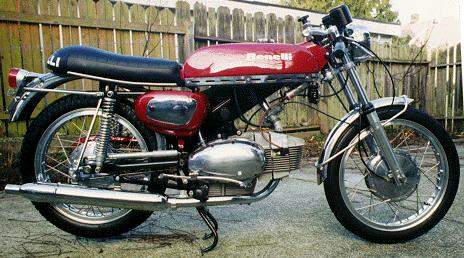
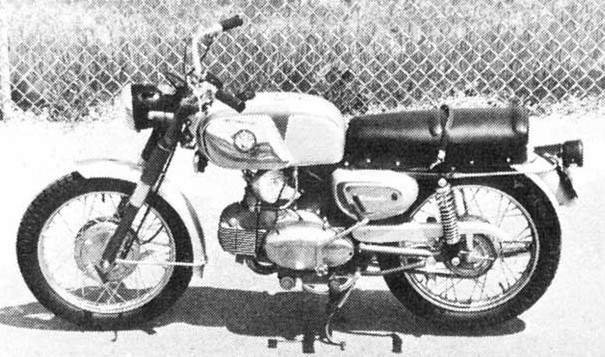
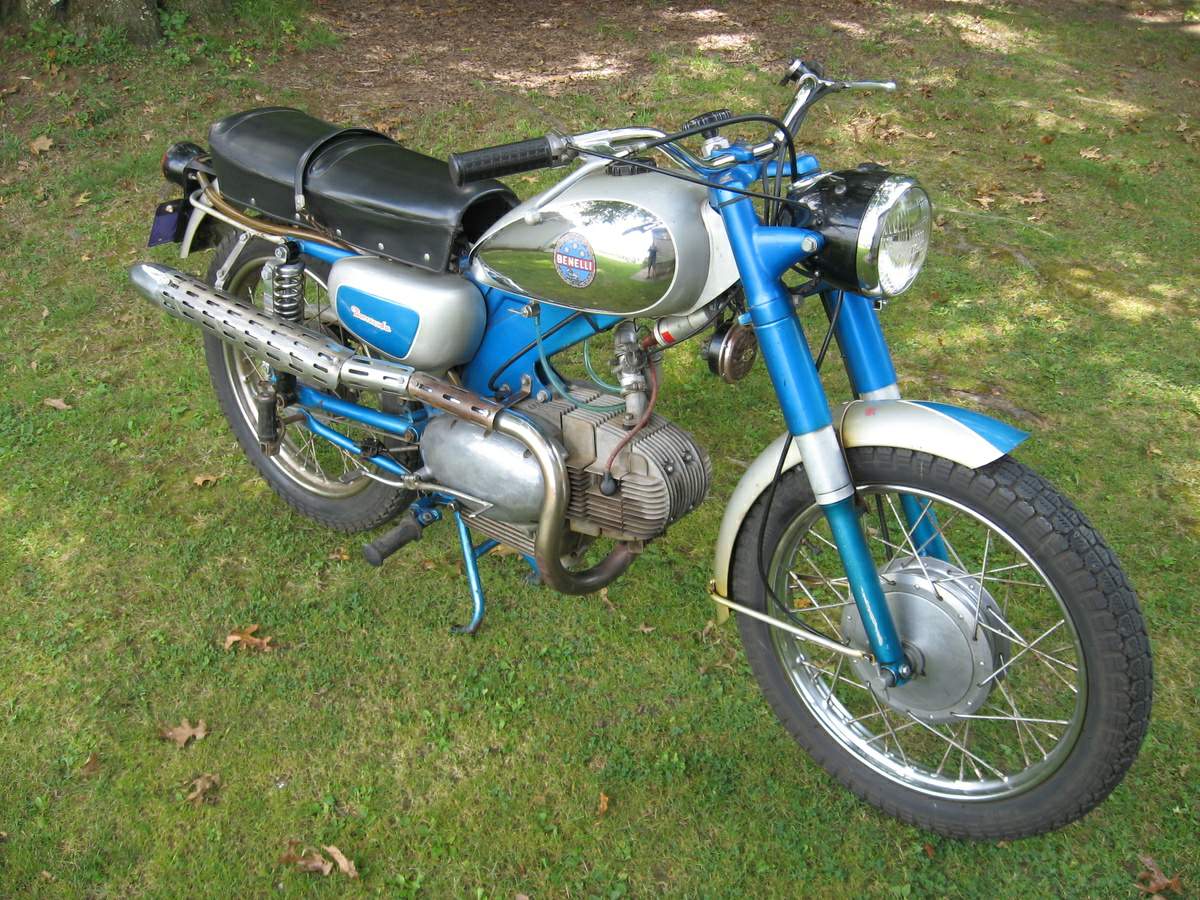
Now you fanciers of fine horseflesh might consider this to be a rather arbitrary, unfair decision and could cite endless accounts of purebred horses going on and on while other animals failed. Well they might have—but don't bother the mountain man with such fol-do-rol; he made his value judgement and he'd stay with it. Enter the Barracuda… while other bikes might flash past her, the Benelli 250 seems to say, "Keep your shirt on Ace. Do you want to get halfway there in record time, or get all the way there today?" Certain differences between the Barracuda and the mountain man's mule should be cited. For instance: from a looks point of view the Barracuda need take a back seat to very few. A snappy combination frame of pressed and tubular steel employs a double-action hydraulic front fork and screw-down steering damper. The rear is gussied up with swing-arm suspension of usual design. The steel gas tank is attractively sculptured to look good and provide a genuine knee-grip on its 3.5 gallon capacity. (In fact, the entire riding position is excellent, with a really nice balance and feeling of oneness with the bike.) The front forks were a trifle soft, but had over three inches of travel and served admirably in all our testing. Stock Pirelli Universals (3.00 x 18 front; 3.25 x 18 rear) didn't hurt the ride, either. The engine also contributes to the bike's looks, being a horizontal unit with an attractive repeated elliptical theme. The 245cc single has a bore of 74mm and a stroke of 57mm. If the power of the unit was commensurate with its appearance, the bike would really perform. As it is, the bike has, we are told, 24 bhp at 8200 rpm.
As readers of CYCLE probably know by now, a race-tuned Benelli won the 250cc Sportsman race in this year's Daytona madness and distributor, Cosmopolitan Motors, is justifiably proud. The kinship of the racer to the Barracuda seems a bit distant to us, however. For, while our test machine exhibited the standard single-plunker tractability, a wind-it-up-and-wail bike it isn't. There is an impression of reserve in all ranges as our top quarter-mile time of 67.85 mph with an E.T. of 18.18 indicates. Now if that reserve could be brought into play through modifications, a much different package might result. It would seem that the builders have tuned for dependability instead of speed and they have succeeded in their aim, perhaps too well. The fact that the bike weighs in at 232 pounds, and seems to afford all manner of possibilities for power-boosting, holds out some hope for all you do-it-yourself nuts; though we believe in letting the factory do it, and wish they had. A prod or two and the engine was purring along, its soothing tones disturbed only by the tiny sip-sip-sip sounds that the wee carburetor was making. Hence, there is a logic to having the low compression ratio and the tiny carburetor throat: i.e. tractability. One other point we have always been quite sensitive to is placement of the kick-starter. The Barracuda is a delight in the ease in which the starter can be swung out and down. At its lowest point the pedal will touch the foot peg, but your foot is safely above and away from any bruising contact. The starting response proved quite good, although ample warm up time is recommended lest the thump-thump sip-sip stop as the gear is engaged and the clutch let out.
When warm-up is completed and the bike is in
fettle, the engine is always quite solid and dependable… a joy in city traffic.
Its light weight and good manners should definitely be considered by the distaff
side of the market, when they get tired of hanging onto hubby's coattails and go
to buy their own iron.
|
|
|
Any corrections or more information on these motorcycles will be kindly appreciated. |