|
|

|
|
|
|
Classic Bikes
Custom Bikes
Individual
Racing Bikes AJP
AJS
Aprilia
Ariel
Avinton / Wakan
Bajaj
Benelli
Beta
Bimota
BMW
Brough Superior
BRP Cam-Am
BSA
Buell / EBR
Bultaco
Cagiva
Campagna
CCM
CF Moto
Combat Motors
Derbi
Deus
Ducati
Excelsior
GASGAS
Ghezzi Brian
Gilera
GIMA
Harley Davidson
Hero
Highland
Honda
Horex
Husaberg
Husqvarna
Hyosung
Indian
Jawa
Kawasaki
KTM
KYMCO
Laverda
Lazareth
Magni
Maico
Mash
Matchless
Mondial
Moto Guzzi
Moto Morini
MV Agusta
MZ / MuZ
NCR
Norton
NSU
Paton
Peugeot
Piaggio
Revival Cycles
Roland Sands
Royal Enfield
Sachs
Sherco
Sunbeam
Suzuki
SWM
SYM
Triumph
TVS
Ural
Velocette
Vespa
Victory
Vincent
VOR
Voxan
Vyrus
Walt Siegl
Walz
Wrenchmonkees
Wunderlich
XTR / Radical
Yamaha
Zero
Video
Technical
Complete Manufacturer List
|
Laverda RGS 1000 Jota
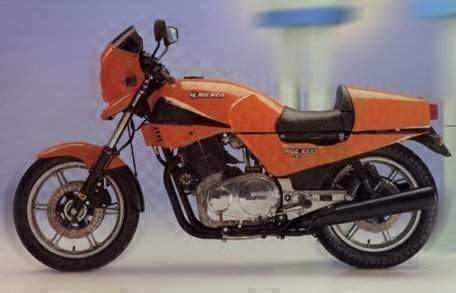
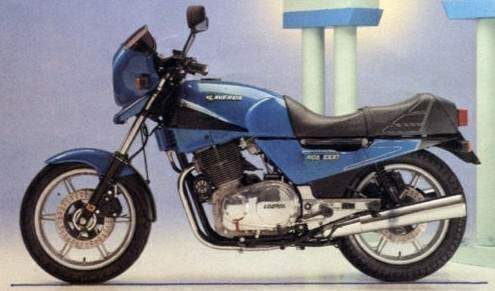
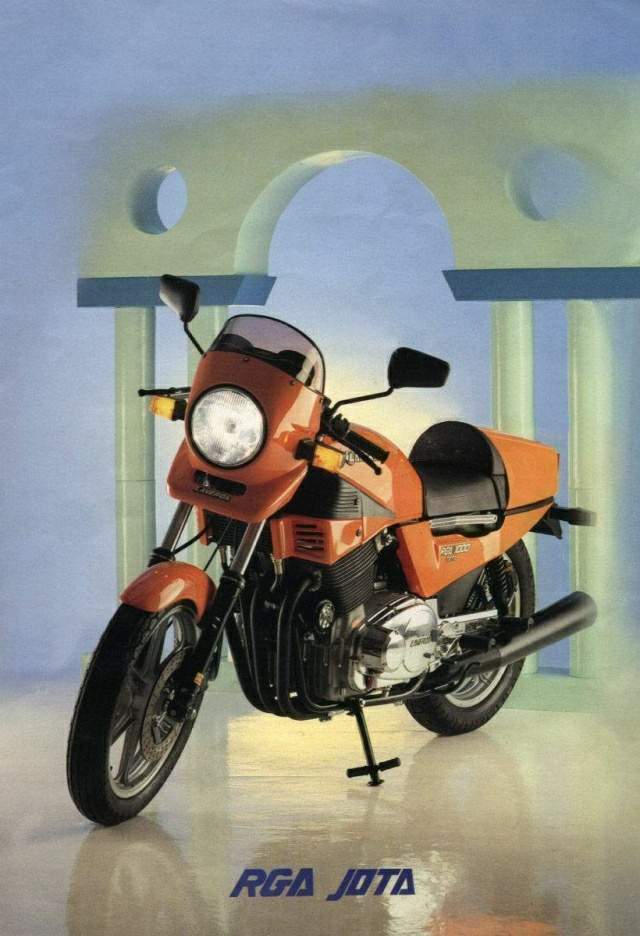
Truly distinctive motorcycles are hard to find these days. There's no question that the Japanese build motorcycles that are unmatched for variety and unequalled for cold, calculated performance; nonetheless, there's a generic similarity about all of them, a certain antiseptic, fault-free sameness that is absent of any discern-able character. For the most part, they lack heart and soul. When viewed against such an homogenous backdrop, Laverda's RGS1000 Corsa oozes character from every nook and cranny. This triple-cylinder hunk of Italian exotica has the kind of quirky behavior and rough-edged personality that is typical of products built by small-volume manufacturers. Visually, its massive engine and hulking silhouette hint that this is no namby-pamby motorcycle, and functionally, its high-effort operation confirms those suspicions. Indeed, riding the Corsa fast on a twisty ribbon of asphalt requires more concentration than finesse, demanding the rider's undivided attention. If the leading Japanese-built sportbikes dissect the swervery with the precision of a scalpel, the Corsa rips and snorts down the road like the world's fastest chainsaw. Its suspension is taut, its steering is heavy, its controls are stiff, and its three-cylinder engine thunders out its power in a way that never, ever, lets you forget that it's down there working. In all, the bike is about as subtle as a poke in the eye, and about as comfortable, too; but those who can look no further than the Corsa's faults will never see its true—dare we say endearing character. Unlike Japanese motorcycles, which usually are an embodiment of the high-volume marketing strategies that emerge from committee planning sessions, the Corsa is a reflection of what one man, Massimo Laverda, believes a motorcycle should be. His brainchild is pretty much an anachronism in America, where stoplight-to-stoplight spurting is of paramount importance and leading-edge technology is in great demand. But that's okay with him, for he knows that in Europe, where the vast majority of his bikes are sold, riders prefer a proven machine that can sustain high average speeds with long-legged strides and unwavering stability. And it is this bike's appetite for fast, winding, European-type roads, combined with Massimo Laverda's refusal to build stoplight racers or please-all appliances, that gives the Corsa its soulful personality. This does not mean, however, that Se-nor Laverda lacks the desire to refine his products, nor that his company has totally ignored the needs of the American rider. This Corsa is far more civilized and emits much less mechanical clatter than any Laverda Triple before it; and our test Corsa launched through the quarter-mile in 11.91 seconds at 112.81 mph, meaning that it not only is the quickest production bike ever to bear the red, white and green Laverda logo, it's also the quickest European motorcycle you can buy. Moreover, the two-valve-per-cylinder Triple produces broad-range power that extends from idle well past the 8000-rpm redline, with a rush of top-end horsepower and a willingness to rev freely that are uncharacteristic of previous Laverda engines. The Corsa's ability to rev past the red zone like the hottest Japanese superbikes is due in part to a number of minor, but effective, weight-paring improvements within the engine's massive sand-cast cases. Reciprocating mass has been reduced through the use of thinner, lighter connecting rods, shorter piston pins and forged pistons that are lighter than the cast pistons used in the previous incarnation of this Laverda Triple, the Jota 1000. The forged pistons also resist heat expansion more effectively than cast units, thus allowing smaller clearances that enhance the sealing properties of the rings, that improve heat-transfer to the cylinder walls, and that reduce noisy piston-flutter, all of which extend the service life of those power-producing components. Most of the Corsa's newfound performance, though, is brought about by redesigned camshafts and larger intake valves. The combustion chamber already was crowded, so the exhaust valves were decreased in size to accomodate the bigger intakes. The valve lift was upped slightly, but the duration of the cams remains the same as on the Jota. What these changes mean is that the Corsa produces more power than the Jota everywhere in the rpm range, with crisp response to throttle inputs at all but very low revs. Below 2000 rpm, the Corsa's throttle response is jerky and irregular. We suspect that this ill behavior is a result of a very abrupt ignition-timing advance that occurs around 1800 rpm, combined with the lean carburetion needed to get the Corsa past the EPA's emission requirements in general, and California's even stiffer CARB standards in particular. Beyond that point, the 981cc engine delivers smooth, steady, uninterrupted power, although it pulls strongest from around 7000 rpm up to— and well beyond—its 8000-rpm redline. In the interest of appeasing American riders, who aren't as likely to compress their riding days with 90-mph-plus jaunts on the backroads as the Europeans might be, the first three gears in the Corsa's five-speed transmission have lower (higher numerical) ratios, with two more teeth on the rear sprocket compared to the Jota. This makes it easier to keep the Corsa spinning in the meaty part of its powerband without having to exceed the national speed limit by a factor of two; and it also has reduced what once was a sizable gap between ratios. These changes, with the aid of extensive sound-deadening refinements inside the engine, make the Corsa a more live able and civilized motorcycle. The engine cases are now thicker and incorporate more ribbing to baffle engine noise, and the crankshaft and transmission mainshaft no longer turn in bearings located in the outer cases. Instead, these shafts run in caged rollers supported by outriggers bolted directly to the engine block, thus reducing the amount of mechanical noise transmitted to the outside world. In addition, the Jota's triplex primary-drive chain has been superseded by two separate single-row chains that run much more quietly. Still, the greatest improvement in the Laverda's civility is the result of the most radical departure from the Triple's original design: the adoption of a conventional (for a three-cylinder engine) 120-degree crankshaft rather than the unusal 180-degree crank used previously. The 180 crank—with its two outer pistons moving up-and-down in unison and firing alternately, and the center piston phased 180 degrees apart from the other two—virtually eliminated the rocking couple that is present with a 120 crank, but caused considerably more primary and secondary imbalance, enough, at times, to rattle the rider's fillings loose. Not so the 120 crank, which produces a much smoother power delivery and, aided by the evenly spaced power pulses and rubber engine mounts, also passes less vibration up to the rider. But while the Corsa's engine is certainly more agreeable than the Jota's ever was, it's still not much of a utilitarian workhorse. There's a noticeable amount of vibration felt through the handlebar and footrest and seen in the smallish, fairing-mounted mirrors. And despite having an improved shifting mechanism, the gearbox clunks during gear changes and the shift lever requires a long throw. European riders may not be as bothered by these traits, however, because the Corsa smooths out considerably once it is locked in top gear and dialed up to stratocruise speeds. To be sure, the Corsa devours huge chunks of country landscape with remarkable ease. Its steering garners high marks for precision and response at triple-digit speeds, with its firm suspension, sturdy frame and sticky Pirelli tires providing confidence-inspiring stability and sure-footedness. Compared to the Jota, the Corsa has a frame that is lower in the rear to bring down the seat height, but sub-six-footers still will find it impossible to plant both feet flat on the asphalt. This change has, however, positioned the rider a little closer to the ground, which also lowers the overall center of gravity. That's why the Corsa is a bit easier to flick into turns than the Jota was, especially for riders who don't hang off when cornering in full-sport mode. Nevertheless, the Corsa still steers more heavily and slowly than any of the current Japanese superbikes. Other chassis refinements include a juggling of the frame's backbone tubes to facilitate easier engine removal, along with recalibrated Marzocchi suspension components. Though still using twin, gas-charged rear dampers and a front fork incorporating 38mm stanchion tubes, the suspension now features softer springing and less rebound and compression damping than on the Jota. The result is a noticeably smoother ride and quicker response to sharp bumps. Compared to the best Oriental offerings, and to the more closely related BMW K100RS, the Corsa's supension still is too unyielding to offer much in the way of all-day comfort. Riding the Laverda at a pace it seems most comfortable with fast but fluid the suspension is too harsh to insulate the rider from small- to medium-size bumps, and it lacks sufficient rebound damping to complement the firm springs. It's not until you begin to push the Laverda to its limits that the suspension and steering geometry make much sense. Despite the effort required to initiate a turn on the Corsa, the steering remains dead-neutral at all speeds, and the bike exhibits little tendency to sit up when the rider brakes deep into a turn. Once the desired line through a corner has been chosen, the bike settles in nicely and shows no tendency to bolt, even when the rider momentarily relaxes. At a more sedate pace, the Corsa feels long, tall and top-heavy, especially when you're trying to herd its 558-pound heft into a tight turn or through city traffic. Laverda has experimented with steering-head angles ranging from 27 to 30 degrees throughout the Triple's lifetime; and it is obvious that the Corsa's numbers 29 degrees, with 125mm of trail cater more Euro-riding than to American preferences. On the wrong road generally one with a lot of tight corners the Corsa demands constant attention. You find that it will wear you out quickly if you ride it extremely hard, and that snap transitions can be made only if you plan ahead and use a decided grunt-and-force-it technique. There are other incentives to keep the Corsa off of ultra-twisty roads and out of city traffic. Though hydraulically actuated, the clutch pull is quite stiff, requiring a strong hand for repeated usage. The throttle-return springs fitted to the DeirOrto accelerator-pump carbs are stiff, as well, and the twistgrip requires about 30 degrees more rotation than usual, forcing the rider into all sorts of right-wrist gymnastics to reach full throttle. And while the Brembo front brake is powerful, it, too, requires high lever-pressure to be fully utilized. Aside from those high efforts, though, the brakes are hard to fault. The European version of the Corsa doesn't have the floating-type brake discs found on the American model (but does have more-radical cams and taller final-drive gearing); and unlike the European brakes, which lose much of their feedback when they get hot, the floating system on the U.S. model allows the discs room for heat-expansion so the brakes can continue to send the rider clear messages when the going gets fast. The rear brake, though, could be a bit more sensitive to inputs from the rider. So, too, could the Corsa's seat be more sensitive to the needs of the rider. The seat is high-crowned, hard and, after more than an hour or so, excruciatingly painful to sit on. But otherwise, the Laverda's ergonomics are roomy and comfortable. True to the bike's Continental sport-touring heritage, the seating arrangement makes the rider bend at the waist and rest most of his upper-body weight on his hands. This position can be tiring at low speeds, but out on the highway enough wind sneaks around the frame-mounted half-fairing to push on the rider's torso and take some of the weight off of his hands. Yet at highly illegal speeds, there is not enough wind noise or buffeting behind the fairing to be disturbing, and weather-protection is excellent, as well. RG Studio in Italy (hence the RGS designation) designed the fairing, along with the unique, smooth-top gas tank that has its filler opening behind a trapdoor at the right-front of the fairing. RG also supplies an optional cowling that fits over the passenger section of the seat and turns the Corsa into a solo machine. The cowling allows the rider to brace himself against a padded butt-rest, which takes some of the effort out of hanging on during spirited backroad workouts, and it also provides storage space for small items. Equally clever are the Corsa's adjustable footrests. Carried on circular plates mounted to the aluminum footpeg/muf-fler brackets, the rider pegs can be rotated 360 degrees (and thus moved back-and-forth or up-and-down) by simply removing an Allen bolt on each side and loosening the lock-nuts securing each peg. All in all, the system provides nearly two inches of vertical and horizontal adjustment of any size. Laverda also offers a host of options for the Corsa, including a higher handlebar with accompanying hardware, a set of color- and style-matched sport-touring luggage, and a 3-into-l exhaust system. We used the stock 3-into-2 exhaust for part of the test (including the gathering of the performance data), but spent most of the time with the optional system in place. It seems to bolster the Corsa's power a bit in the midrange while not making a noticeable performance difference anywhere else. It is lighter, though, and at full-throttle, a bunch louder. But that's right in keeping with the Corsa's imprudent overall personality. Despite its ongoing refinement, the bike still is fundamentally a crude device compared to the best the competition has to offer. Most Japanese sportbikes not only can outgun the Corsa on the straights and through the turns, but also are more comfortable, less quirky and a bit cheaper, to boot. Based on past performance, though, at least a Corsa owner can expect his trusty mount to endure, for Laverdas have proven mechanically bulletproof if nothing else. So those who ply their skills on Oriental weaponry undoubtedly will find it easy to assassinate the Laverda no matter what. The bike is like a Roman warrior who headed into battle sheathed in steel armor: He was hard to pierce but an easy target nonetheless. So it seems logical that the average rider will find dis-couragingly little about this beast from Breganze to admire. But the not-so-average rider, the person who stays as far away from mainstream motorcycles as he possibly can in favor of something with more individuality, just might find a good friend in the Laverda. See, the RGS 1000 Corsa is more of an end in itself than it is a means to another end like so many other motorcycles. It's a traveling companion, not a transportation contrivance. It's appealing because of what it is, not because of what it can do. That's simply another definition of character. SSource Cycle World 1984
|
|
|
Any corrections or more information on these motorcycles will be kindly appreciated. |