|
|

|
|
|
|
Classic Bikes
Custom Bikes
Individual
Racing Bikes AJP
AJS
Aprilia
Ariel
Avinton / Wakan
Bajaj
Benelli
Beta
Bimota
BMW
Brough Superior
BRP Cam-Am
BSA
Buell / EBR
Bultaco
Cagiva
Campagna
CCM
CF Moto
Combat Motors
Derbi
Deus
Ducati
Excelsior
GASGAS
Ghezzi Brian
Gilera
GIMA
Harley Davidson
Hero
Highland
Honda
Horex
Husaberg
Husqvarna
Hyosung
Indian
Jawa
Kawasaki
KTM
KYMCO
Laverda
Lazareth
Magni
Maico
Mash
Matchless
Mondial
Moto Guzzi
Moto Morini
MV Agusta
MZ / MuZ
NCR
Norton
NSU
Paton
Peugeot
Piaggio
Revival Cycles
Roland Sands
Royal Enfield
Sachs
Sherco
Sunbeam
Suzuki
SWM
SYM
Triumph
TVS
Ural
Velocette
Vespa
Victory
Vincent
VOR
Voxan
Vyrus
Walt Siegl
Walz
Wrenchmonkees
Wunderlich
XTR / Radical
Yamaha
Zero
Video
Technical
Complete Manufacturer List
|
Laverda 650 Formula
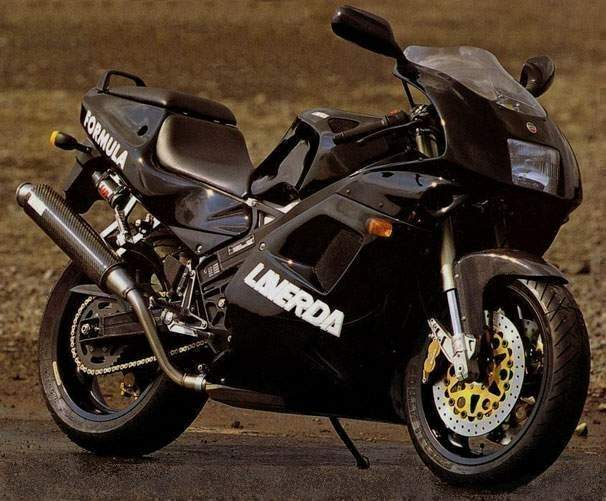
Rarely can a new motorcycle have come in a less appropriate colour than Laverda's 650 Formula, which is available only in black. That's not just because the Formula inevitably looked rather dull on the grey autumn day that it was launched but because this bike, above all others, should not come dressed for a funeral. Contrary to reports of two years ago that Laverda had finally died, it is further proof that the firm is very much alive. The Formula is the first new machine to be introduced since Laverda, under new management, finally commenced production of the much-delayed 650 Sport just over a year ago. In fact, describing the Formula as a new model is something of an exaggeration, because the parallel twin engined sportster is heavily based on the Sport. But for Laverda, now headed by youthful textile millionaire Francesco Tognon and based at Zan, close to the famous old factory at Breganze in north-eastern Italy, this bike represents another landmark on the road to full recovery. The black bike is powered by the Sport's fuel-injected, DOHC eight-valve parallel twin engine, cooled by a mixture of air and oil. Claimed peak output remains 70bhp at 8900rpm. In Formula guise the engine gets an uprated, nine-plate clutch, plus carbon-wrapped silencers. The Weber-Marelli fuel-injection system can also be fitted with a Stage 2 EPROM chip, which gives added midrange power but is not homologated. (The chip is an optional extra, and can also be fitted to the Sport.) Much of the 650 Sport's chassis is retained, including the twin-spar aluminum frame, multi-adjustable suspension parts from Dutch firm WP, and 17-inch Marchesini wheels. The Formula differs in that its front brake set-up, consisting of 320mm discs and four-piston Brembo calipers, is uprated with fully-floating rotors and a Brembo racing master cylinder. The new bike's front mudguard and footrest shields are carbon-fibre, and its fairing is hand-made in fibreglass modifications that combine to save a few kilos from the Sport's 396lb dry weight. Predictably, such limited changes do not transform the feel of the Laverda, which remains essentially a moderately powerful but impressively agile sportster. The chance to thrash the new bike around Mallory Park racetrack in England confirmed my impression that the frame is highly rigid, and the suspension well-damped (although set up slightly soft for track use in this case, especially at the front. The new brake set-up gave powerful stopping with plenty of feel, and maintained its performance at the track. My only real chassis criticism was that, as Laverda's super-sports model, the Formula would have been better off with softer rubber than the competent but hardly ultra-sticky Pirelli Dragon GTs, which slid fairly early on the cold and sometimes slippery track. Laverda's faithful parallel twin motor was never likely to be as impressive as the chassis, but the Formula gave respectable performance considering that it is basically a development of a powerplant that has been around since the 1970s. The injected engine revved fairly crisply, didn't vibrate too badly although a buzz could be felt, mainly through the footpegs, at higher revs and would have sent the aerodynamic Formula to a top speed of about 135mph if given a longer straight. The midrange Eprom chip gave a distinct boost in the 4000-5500rpm range at which the standard 650 Sport is rather flat. Although this was of little benefit on the track, where revs were generally much nearer the 9000rpm redline, it would give a significant improvement in roll-on acceleration on the road where the Formula would be more at home. A Formula fitted with a Termignoni race exhaust system, another optional extra (for track use only) predictably had more power and a rich, deep exhaust note until that bike broke down, apparently with an alternator problem. The third bike prepared for the launch was sidelined with gear selection difficulties, which was rather worrying. In this context, two out of three ain't bad it's awful. Hopefully Laverda will get such quality control problems sorted out fast. Provided that happens, the 650 Formula will make a worthwhile rival for Ducati's 900SS, as a light and good-looking sportster that makes up with handling what it loses to many rivals in power. The Formula is likely to cost ten per cent more than the 650 Sport, putting it roughly level on price with the 900SS. Unusually, the Formula will be sold, at least initially, in only five European countries. These are Germany, Belgium, France, the Netherlands and Britain but not Italy. That seems a strange approach until you realise that it allows Laverda's small factory to deal with just five customers the five importers rather than the many dealers that would be required for a domestic sales network. Moves into other export markets are planned, possibly starting with Australia early next year, as Laverda attempts to regain its worldwide reputation. Meanwhile the firm's resources are being concentrated on producing six bikes a day over double the figure of a year ago and developing new models for the future. These are likely to include a new watercooled, DOHC three-cylinder sports bike, a descendent of the legendary Jota 1000 of the 1970s, which is due to debut in 1998. Long before that Laverda will introduce another variation on the parallel twin, a naked roadster combining the Formula's 688cc engine with a Ducati-style steel ladder frame. This new bike, which Laverda hopes to have ready for launch at the Milan Show this November, will retain the Formula's fuel-injection, its 70bhp output, and most of its cycle parts including WP suspension, Brembo brakes and Marchesini wheels, and will be considerably cheaper than both the 650 Sport and Formula models. Laverda chiefs are hoping that the new roadster, intended as a rival for Ducati's Monster, will allow the factory to double production from this year's likely total of about 700 bikes. That level of output will not worry Ducati much, but the increase provides further evidence that Laverda is back from the dead. So, too, does the naked bike's name it will be called the 6
|
|
|
Any corrections or more information on these motorcycles will be kindly appreciated. |