|
|

|
|
|
|
Classic Bikes
Custom Bikes
Individual
Racing Bikes AJP
AJS
Aprilia
Ariel
Avinton / Wakan
Bajaj
Benelli
Beta
Bimota
BMW
Brough Superior
BRP Cam-Am
BSA
Buell / EBR
Bultaco
Cagiva
Campagna
CCM
CF Moto
Combat Motors
Derbi
Deus
Ducati
Excelsior
GASGAS
Ghezzi Brian
Gilera
GIMA
Harley Davidson
Hero
Highland
Honda
Horex
Husaberg
Husqvarna
Hyosung
Indian
Jawa
Kawasaki
KTM
KYMCO
Laverda
Lazareth
Magni
Maico
Mash
Matchless
Mondial
Moto Guzzi
Moto Morini
MV Agusta
MZ / MuZ
NCR
Norton
NSU
Paton
Peugeot
Piaggio
Revival Cycles
Roland Sands
Royal Enfield
Sachs
Sherco
Sunbeam
Suzuki
SWM
SYM
Triumph
TVS
Ural
Velocette
Vespa
Victory
Vincent
VOR
Voxan
Vyrus
Walt Siegl
Walz
Wrenchmonkees
Wunderlich
XTR / Radical
Yamaha
Zero
Video
Technical
Complete Manufacturer List
|
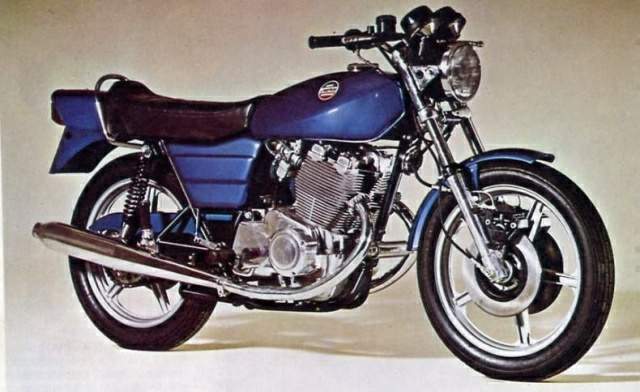
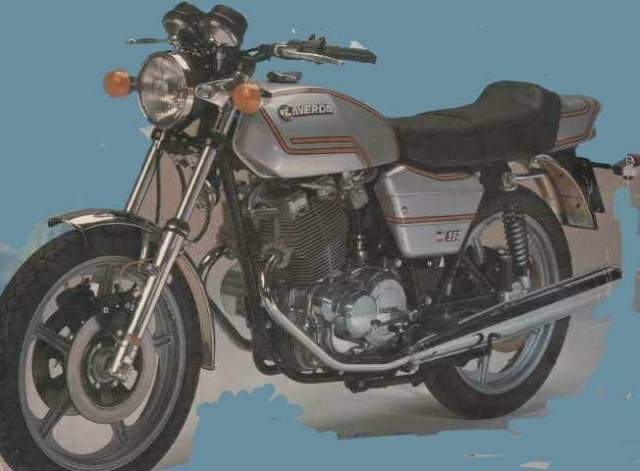
Laverda 500 Alpino
The HE NAME Laverda has always stood for quality— quality engineering, quality finish, and that Italian flag emblazoned through the L means that Laverda is one of the finest Italian motor cycles. The big news from Laverda is that three new
superblkes have been added to their range this year—Increasing their 1,000cc
offering to five bikes. But taking a backseat position behind the Jotas and
Corsas is a machine some call the half Jota, the Alpino. Compared to some others in that class the Alpino
Is rather basic, being only a parallel twin. But it's nice to see the sport
version is the same price. This is because both have twin cylinder, eight
valve engines with lots of torque at low revs, and both are mechanically
noisy—the Laverda not quite so noisy as the Triumph. I didnt have the chance to speed test the Alplno
myself, and had to leave It in the capable hands of Road Test Editor Mat Oxley.
Speed, though, wont be the main consideration of the Alplno owner. It managed a
quite respectable mean top speed of 103.44mph. This was 1mph less than when we
last tested the Alplno In 1977. It's interesting to compare the top speed with
the Alplno S, tested in 1978, even though the 'S' has a performance camshaft and
a higher compression ratio the top speed was only 105.15mph. The quarter mile times are again in keeping with
the other speeds. At 14.17sec/90.47mph, the 500T is slower than the last Alpino
test, slightly quicker than the Alpino S, but this time quicker than the Honda
CX500. The gearbox was very precise and slick. Up or down changes were good, and it was very easy to slip it into neutral from first gear at a standstill. Much better than the other Laverda on test at the same time, the RGA. The engine is fed by a couple of Dell'Orto 32mm carbs with the choke fitted on to the left hand one. It was tricky to flick the lever on and off due to it being right behind one of the two fuel taps. The choke worked well, bringing the engine on to a fast idle speed of 3,500rpm, useful In winter but not needed during high summer. You'd think that with a pair of 32mm DeH'Ortos that the Alpino would be thirsty—but happily the opposite happened in practice. All the mpg figures were between 51 and 49, which would give a good average of around 50mpg if it were not for a low 35.8mpg at MIRA. This brought the overall mpg down to a lowish 44.6, the lowest of our comparisons except for the Alpino S. Most riders will not get such a low figure as 35.8mpg, even with fast motorway riding, and so should expect a higher average. Motorway riding is comfortable at anything up to
the legal limit, above this vibration took its toll—mostly through the bars.
Sustained riding speeds of above 90mph were impossible, but at 70-75mph you
could last all day. The riding position again reminded me of the Triumph
TSS—upright with straight bars, and sitting quite high up. The seat height at 32
inches is higher than normal. My first impression of the seat was that It was
rock hard. But during the test I concluded that it was merely firm. It did
support very well on long rides, unlike a super soft seat that will feel OK To aid the riding position the footrests (which
were polished alloy) were adjustable forward or backWard.
The rear units, if anything, are a little on the
hard side—the norm with standard Marzocchis. They were not so hard that they
made riding uncomfortable, but just the right balance so that it handled fine.
To quote from a past Laverda road test, written by
our fearless editor Graham Sanderson: "The Italians' realising that they are to
electrics what Charlie Chaplin is to the Royal Ballet, have changed over to
Japanese electrics". This sums up what the Italians electrics were like. Now a
few years later the combination of Japanese and German wizards Bosch makes the
electrics almost perfect.
About the only thing Laverda have skimped on
throughout the bike is the lack of any wing mirrors fitted as standard. This I
find unacceptable, and totally out of character with the standard Laverda
approach on their other machines. Listen Laverda, if you do start to fit wing
mirrors on the Alpino please do not make them like the ones fitted on to the new
RGA—they fell off at 125mph! Source Motorcycle Weakly
|
|
|
Any corrections or more information on these motorcycles will be kindly appreciated. |