|
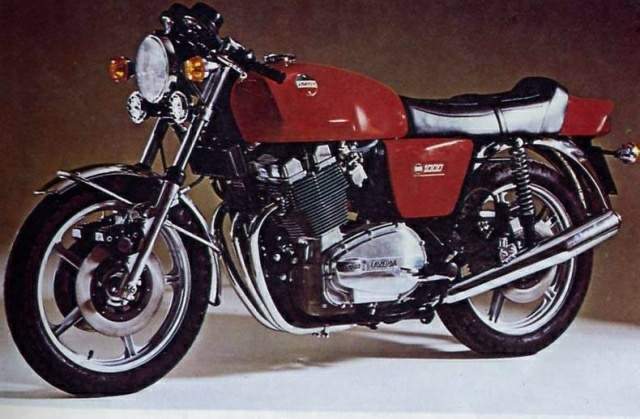
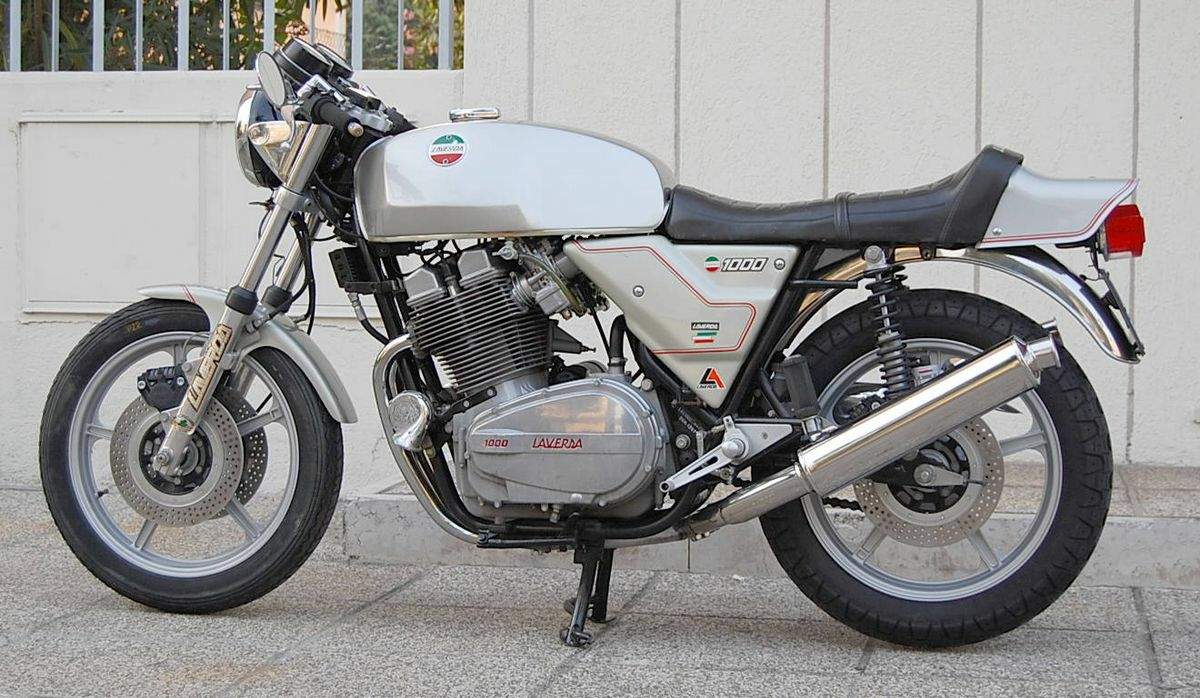
Laverda 1000 3C

|
Make Model |
Laverda 1000 3C |
|
Year |
1977 |
|
Engine |
Air cooled, four stroke, transverse three cylinder, DOHC,
2 valve per cylinder. |
|
Capacity |
981 |
|
Bore x Stroke |
75 x 74 mm |
|
Compression Ratio |
9.0:1 |
|
Induction |
3x 32mm Dell'Orto PHF carbs. |
|
Ignition /
Starting |
Bosch electronic |
|
Max power |
80 hp 58.3 kW @ 7250 rpm |
|
Max Torque |
86 Nm @ 5000 rpm |
|
Transmission /
Drive |
5 Speed / chain |
|
Front Suspension |
Telescopic forks |
|
Rear Suspension |
Swinging fork |
|
Front Brakes |
2x 280mm discs 2 piston calipers |
|
Rear Brakes |
Single 280mm disc 1 piston caliper |
|
Front Tyre |
3.25 H19 |
|
Rear Tyre |
4.00 H18 |
|
Dry-Weight |
214 kg |
|
Fuel Capacity |
20.5 Litres |
|
Consumption average |
40 mp/g |
|
Top Speed |
123 mp/h |
Dave Minton has been riding Laverda
triples for over 30 years. Meet his favourite and be surprised: it's no Jota
(but it does make all the right sounds)...
At between 2500 and 4000 revs in the higher gears, 180-degree Breganze triples
make wonderful noises -- a sort of basso profundo gargle, not unlike a narrow
angle V-twin. Just as it begins to fade, the accompanying parallel twin underlay
swells from an inconspicuous moan to a howl of released power.
We were on our way back to Britain with the first Laverda triple, the 3C, Roger
Slater (who held the British Laverda concession then) and I. Winter arrived
early in the Alps that September in 1972 and our lightweight summer gear was
insufficient to deal with unseasonable bitter cold and deep snow over what I
recollect was the St Bernard pass (although it may have been another). So we
took the rail ferry through the tunnel and exited in a Switzerland buried
beneath a few feet of ice and snow.
Roger seemed to think it was all a bit of a giggle at first. Well, he would,
because while he was secure on an ordinary 750SF, I, being the privileged
journalist, had sole responsibility for the precious new press-demo 3C. After a
few miles 'tight-rope' riding down the mountain road while I sweated in fear of
disgracing myself, while simultaneously freezing in the blistering cold, we
stopped at the first village and booked into the only hotel.
With numbed fingers we failed to release our crash helmet buckles and had to sit
in the reception lounge cuddling glasses of mulled red wine until feeling
returned. Roger was displeased because while following me he noticed that I had
been 'snatching at it' -- he had seen the 3C's chain shaking under low-speed
combustion pulses. It was no good arguing with him.
Eventually we managed to remove our helmets and settled in the snow-besieged
hotel to await snowploughs. I attempted without much success and borderline
honesty to explain to Roger that the 'snatching' which had so offended him was a
consequence of the dire need to keep revs down over snow and ice. What I did not
confess was my compulsion for the 3C's lusty low rev torque and magnificently
off-beat exhaust throb! I simply could not get enough of 3000rpm-ish high gear
acceleration whenever possible.
We left the following morning. The steep mountain pass was clear of snow but
polished to a glaze by the plough blade and other vehicles. Thankfully the road
eventually cleared and the rest of the ride passed uneventfully, save for a
lunch of staggering proportions near Chalons, which Roger beamingly recorded as
a; 'real Froggy blowout', taken in celebration of our survival.
I was smitten and have remained so ever since. You have to remember that this
was 30 years ago when the Kawasaki Z1 had only recently arrived. While its 82bhp
engine was at least the equal of the 3C, its rolling chassis' weak-kneed and
imprecise performance was not. Japan had yet to grasp that unless it was cradled
by reliable brakes, disciplined suspension and a torsionally stiff frame, the
power of an engine could never offer much more than notional potency.
This was never the way of the 3C. From the word Go it was pure sportster. A
little harsh by way of stiff suspension and, perhaps, not quite as smooth in its
power delivery as the Z1, but it would scorch to 130mph without much more than a
mild and harmless rear end squirm. At least, the cast aluminium wheeled models
would, for I had a few funny moments on the wire-wheeled pre-Jota 3CEs,
but that's another story.
Two long, hard trips to Italy on the big triples convinced me of their fine
qualities. They were incomparably fast, tireless and safe under all conditions
at a time when 'trustworthy' was rarely employed to describe sporting
attributes. You could brake in the rain on the 3C's big Brembos. Do you remember
how Italian bike owners, red-eyed and black fingernailed from unscheduled
servicing, would with immense pride exemplify their trusty, red oxide dusted
brake discs? And immaculate Japanese bike owners would point out that at least
their bikes kept running in wet weather, even though they might not stop running
when so ordered!
Before the 3C had properly settled, Slater Brothers developed the Jota.
Following almost a year's development on the track in the hands of mainly Peter
Davies and Roger Winterburn, and on a Heenan and Froud dynamometer (JAP's old
one, oddly) in the hands of Roger and Richard Slater, the awesome Jota blew
everything, including its 3C brother, through the weeds and into the wilderness
beyond.
As well as dominating the Avon Production racing Championship throughout the
latter Seventies, the Jota has much greater PR and endurance racing success than
it usually gets credit for: a 1974 third place at Barcelona, fourth at Thruxton;
1975 sixth at Barcelona, third at Mugello, second at Spa; 1976 Italian PR
Championship, Austrian PR Championship, as well as the Avon series in Britain.
While all this was good for Laverda it was hard on the standard 3C, which by all
standards save that of extreme speed was superior to the Jota. It was also a
bare 10mph slower, undeniably sweeter and possessed a very useful power plateau
beginning at 2500rpm, a mere 45mph in top gear: the Jota's power crashed in,
almost literally, at 6000rpm -- 108mph.
Unfortunately the rough, tough legend of the Jota spilled over to stain the
standard 3C which was then, and remains today, far from the coarse and raw
animal it is supposed to be. When I first rode a pre-production drum-braked
example back in, oh, 1970 was it (?), the big three felt massive. Now, compared
to, say, an initial Hinckley triple, the Breganze bike feels nice, neat and
cobby, light and flickable as a modern 600. But rugged, too. Alas, they really
don't make 'em like this any more.
Unlike their 750cc twin cylinder brothers' impregnable reliability, the triples
-- while generally good -- were not faultless. But, of course, rumour proved
stronger than fact. The first year's production revealed a vulnerability to
dampness of the Bosch ignition signal amplifiers. Then came the batch of faulty
camshaft bearings. Certain models exhibited camshaft pillar crumbling, although
this proved to be as much a problem of incorrect assembly as anything else.
Others suffered from loosened valve seats. Slater Brothers either dealt with
these under warranty themselves or factory mechanics handled mass rectification
work.
Any 3Cs by this time are either one of the majority without defect or have long
since been corrected. Minor problems displayed by exceptionally hard-ridden
models are very occasional front mudguard stay fracturing caused by the tele-leg
'walking' under high speed duress, and instrument bracket fractures.
The only insurmountable difficulty has been the miserably weak Bosch alternator.
No others were available from any electrical specialist. The first models had to
make do with an insufficient 100W to maintain a fully charged battery at night.
By the second year generator output was just about enough to balance a headlamp
load at 125W and this lasted through to 1978 when 140W was provided. Owners of
125W models are advised to fit a 21W daytime riding lamp bulb in place of the
parking lamp, and if planning a winter's night-long ride to ensure they have one
of the original 32ah batteries fitted...
The bike seen here was supplied by John Fallon, proprietor of Mdina Italia.
Laverda triples, it seems, inspire him with confidence; 'Some older Italians can
be a can of worms,' he says, speaking from experience. 'You open them up and
everything's worn. But if there's trouble with an old Laverda I know that I can
replace the problem part and the rest will be fine. No problem.
'They just go. And they keep on going.'
Source
Realclassic.co.uk
|