|
|

|
|
|
|
Classic Bikes
Custom Bikes
Individual
Racing Bikes AJP
AJS
Aprilia
Ariel
Avinton / Wakan
Bajaj
Benelli
Beta
Bimota
BMW
Brough Superior
BRP Cam-Am
BSA
Buell / EBR
Bultaco
Cagiva
Campagna
CCM
CF Moto
Combat Motors
Derbi
Deus
Ducati
Excelsior
GASGAS
Ghezzi Brian
Gilera
GIMA
Harley Davidson
Hero
Highland
Honda
Horex
Husaberg
Husqvarna
Hyosung
Indian
Jawa
Kawasaki
KTM
KYMCO
Laverda
Lazareth
Magni
Maico
Mash
Matchless
Mondial
Moto Guzzi
Moto Morini
MV Agusta
MZ / MuZ
NCR
Norton
NSU
Paton
Peugeot
Piaggio
Revival Cycles
Roland Sands
Royal Enfield
Sachs
Sherco
Sunbeam
Suzuki
SWM
SYM
Triumph
TVS
Ural
Velocette
Vespa
Victory
Vincent
VOR
Voxan
Vyrus
Walt Siegl
Walz
Wrenchmonkees
Wunderlich
XTR / Radical
Yamaha
Zero
Video
Technical
Complete Manufacturer List
|
Indian Scout
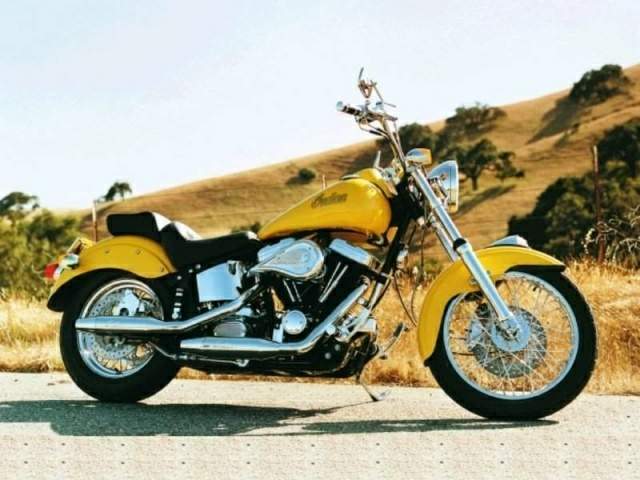
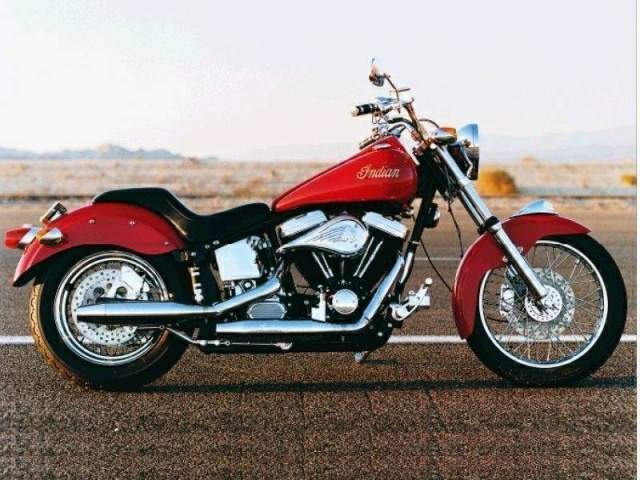
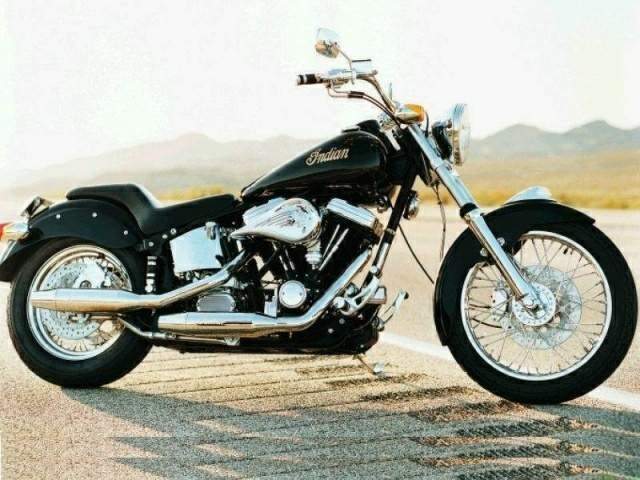
Review by Victor Wanchena and Sev Pearman It is a 45 year long story with enough twists and bends to make your head spin. I refer to the saga of Indian Motorcycle Company. Once the industry leader in motorcycles, by the early 50's they had fallen on hard times. Low profits had forced the company to close its doors. The years saw the marquee fall into a trading game. The only real viable asset left to Indian was their name and the all too famous script logo. The rights to the name traded hands and even ended up for a while on the Royal-Enfields produced in the country of India. The story gets a little foggy after Enfield. The name eventually was used by several groups that tried to resurrect the Indian brand, but all failed horribly. That is until now. In 1998, all the court battles over the name finally came to an end. The result was a merger of several companies into the Indian Motorcycle Company that we know today. Starting simple, they released a limited edition Chief for 1999. The following years have seen the release of two additional models. First the Scout and now the Spirit. That brings us to this month's test ride, a 2001 Indian Scout. This second model in the Indian lineup is patterned to reflect what the original Scout role was. It is lighter, faster and handles better than its big brother the Chief. But can it live up to all the expectations and carry all the baggage that accompanies the legendary name that resides on its tank? Read on and find out. The time arrived for me to pick up the Scout from it's gracious owners, Thomas Indian Motorcycles. What a perfect day. The weather was finally in the sixties and the sun was shining bright. I strolled up to the bright yellow bike and took a good long look. This bike is an attention getter. The color itself was enough to draw your attention and the attention of everyone else in the near vicinity. After spending a few moments to get familiar with the bike, I hopped on and thumbed the beast to life. The starting procedure was basically the same as any other bike. Open the choke, hold in the clutch, crack the throttle and hit the start button. The 88 cubic inch motor spun to life with no hesitation. A few moments to warm up and I was on the road. The heart of the Scout is an 88ci (or 1442cc for you metric types) S&S v-twin. For those not familiar with S&S, they are the one of the largest suppliers of direct replacement parts for Harley motors. They make everything to the point where you can assemble an entire Harley "clone" motor out of S&S parts. And that's exactly what Indian does. They special assemble the motors to their specs in their Gilroy, California factory. The motor puts out a claimed 75 horsepower and an unspecified amount of torque (we guess around 80 foot pounds) and though unverified, it felt accurate. Otherwise the motor is very similar to the H-D Evo that has been a staple in the American cruiser diet for years. Before you get too hard on Indian's case for not having their own motor, remember that to develop a new motor from the ground up cost a minimum of 10 million dollars. You need to sell a lot of bikes to recoup that kind of cash and for a start up company it is always wiser to spend your capital frugally. For the record, Indian has stated that they are working on a motor of their own. The transmission is a 5-speed copy of the H-D unit built by Rev-Tech. It works well and has a very positive feel when shifting, but requires a fair amount of effort. The primary drive as well as the secondary drive are both belt driven. If you aren't familiar with belt drive, it has its pros and cons. It is light, quiet and requires little maintenance, but it also can fail suddenly if the belt is torn and is impossible to repair roadside. The clutch is a dry system that I find no fault with, though riders used to wet clutches may need some time to adapt. It should also be noted that the newest Indian model, the Spirit, has a transmission and primary drive system of Indian's own design. It should find its way to all the models in the Indian line by next year. The running gear of the Scout is quality merchandise. I was thoroughly impressed by the fit and finish of the bike. The choices of paint colors was very nice varying from red and yellow to the ever present black. The Indian motif is found throughout the bike from the arrowhead shaped cutouts in the frame to the light-up "war bonnet" emblem on the fender. The suspension is adequate boulevard cruising not much more. The switch gear is also of H-D descent and is simple except for the turn signals, which always confuse me. I understand pushing left to turn on the left blinker but the whole push both to turn it off continued to fluster me. I often would hold both buttons down too long thus turning on the hazards. On the plus side, Indian has a couple of impressive safety features. First off, the brakes are top notch. They were not only strong but also very linear which equals good control. Despite having only a single disc front and rear, the brakes on the Scout felt as good as many sport bikes. A far cry from the tiny drums on the Indians of old. The other neat safety feature was the fact the rear turn signals were wired to both flash three times when you hit the brakes. This did wonders to make the Scout highly visible to any one who approaches from the rear. A more poetic MMM staffer referred to it as being "visually arresting". Now I have never described my self as a "righteous bro in the wind" but I immediately felt comfortable on the Scout. As I cruised around town I discovered just how much attention a bike like this gets. People everywhere were giving me the high sign, running across parking lots to talk with me about the bike. Two kids pedaling by on bikes even ran into one another while the bike was parked. I felt like was in a parade. The Scout did hold a couple of surprises for me. First, I never expected it to handle as nicely or have even half the cornering clearance that it has. I would not describe the handling as sporty but the Scout does let you lean in the corners, which is more than can be said for a lot of cruisers. The other surprise was how much vibration can come from a solid mounted v-twin. The Scout does vibrate enough to make you a little surly by the end of the ride. In all, I am glad to see Indian doing as well as they are. The Scout is a well put together machine built from high-end components. Those parts coupled with relatively low production volume do mean that you pay plenty for a Scout. The MSRP is about 19 thousand. But Indian has had steady sales and have positioned themselves well for the future. They are definitely not just making another H-D clone. The Scout is a unique machine befitting its 100 years of heritage. by Sev Pearman I'm cursed. Every time we get a heavyweight cruiser to review, it snows, and our time with the beautiful Indian Scout was no different. I'm not reviewing another big V-twin unless it is in August. I ride on average 10,000 miles a year, and test ride several bikes annually. I have never noticed more attention, gawkers and thumbs up while on a production bike than during my time with the Indian Scout. Everywhere I went, people would emerge from their snow caves and ask questions. One guy passed us, stopped his truck and actually ran over to the bike. If you want to make a statement, get yourself an Indian Scout.
The resurrected Indian Motorcycle Company came out of the legal ashes of several fly-by-night carpetbaggers as well as the merger of "clone" builder California Motorcycle Company and the American Indian Motorcycle Company. Confused? We are too. Essentially what you have is respected big-twin builder CMC entering into a new partnership, to build H-D Evo clones under the reborn Indian trademark. For those of who have been in a CZ riding coma since '62, several companies sprang up in the 90's to fill the big cruiser vacuum created when H-D couldn't, some say wouldn't, meet demand. Because of the extensive after-market, it is possible to build a complete "Harley" out of non-H-D parts. These "clone" companies such as Big Dog, Illusion, California Motorcycle Company, etc. would assemble complete bikes to the customers specifications, with a shorter wait than for a stock Harley, at a comparable price to a mildly customized Harley. At least that is the way it is supposed to work. When the Indian trademark began to emerge from its legal coffin, CMC aligned itself with AIMC, and in 1999 began to produce the "new" Indian Chief. In 2001, the Indian Motorcycle Company offers the Chief, the all-new Spirit, and the Scout, tested here. Whether or not these are Harley-Davidson clones in different clothes I'll leave to the "Enthusiast Philosophers." What you have is a 45-degree S&S V-twin boasting 88 cubic inches. Like the H-D Evolution motor it is based on, it spins one camshaft and push rods. Carburation is by the tried-and-true (read: traditional) S&S E-type. It flows more fuel than a Keihin, which helps the motor make a little more horsepower. In addition to the final drive, the primary is also a belt. The clutch is dry. This means no oil level to monitor or change as well as quieter operation. Under fire, we noticed the friction zone to be relatively narrow, but workable. I'll gladly trade the clutch's "feel" for one-less maintenance chore. Tranny is a Rev-Tech 5-speed, one-down, four-up. This is a quality unit made by an established company. Shifting, while not GSX-R precise, is very tight for a big twin. This is made even more remarkable due to the Scout's forward controls. Forward controls tend to be sloppy for two reasons. One, they add linkage between the gearshift and transmission, which adds play; and two, you lose the power of your thigh muscles to help change gears. While we could find no false neutrals between gears, I found it hard to find neutral from second, while either rolling or stopped. I usually had to go down into first and then ease on up from there. The gear oil was undoubtedly thickened with temps in the low 30's, and tranny action did get better as temperatures climbed. This is one of those things that either go away during break-in, or the rider simply learns to compensate. I have less than 5,000 miles in total on big twins, but "The Faithful" tell me the shifting technique can be learned; that it comes with experience. It's up to the potential owner to decide if she/he wants to surf this particular learning curve. The clutch is cable-activated and is robust. It requires a hefty pull, which could become a chore in downtown Sturgis traffic. Combine highway speeds and that sweet belt-primary however, and it is one tidy system, consistent and fade-free. Both clutch and brake levers are non-adjustable. Even with the pronounced doglegs, it is quite the reach, even with my XXL-sized gloves. This is no doubt one of the many areas a custom cruiser buyer will sacrifice practicality for style. This ain't all bad. If we ignored style completely, we'd all be riding brown '79 CX-500s with a milk crate bungeed to the back. The brakes are phenomenal. Period. Both wheels spin single discs pinched by polished 4-piston calipers carved from billet aluminum. The lever feel was linear and progressive. Squeeze harder, stop sooner. I was unable to lock up the rear wheel due, again, to the non-ergonomic forward controls. While it is safer to avoid skids in general, I'd rather a little more control through my feet. I guess I've got just too many miles on BMWs. Another surprise? The ample cornering clearance. I was unable to ground any parts at all, despite generous cornering speeds and my 230 lbs. of shock compression. No doubt the raised forward controls bought a few degrees of lean, as did the tastefully tucked twin right-side exhausts. It'd be interesting to compare the Indian Scout to Victory's 92 SC. The ride is the typical big cruiser. Park your ass in the seat, put your feet forward, and try to suppress your silly grin with the mandatory affected sneer. Feet forward may be fine for extended freeway cruising, but I quickly grew tired of the "Stairmaster routine" at every stop while in town. Did I mention that I am a traditional footpeg guy? It's just as well, as I got butt-burn as the tank went to reserve. With but 3.5 gallons capacity, the potential for high-40's economy gives you, on a good day, a range of St. Paul - Duluth. Your actual mileage may vary. Instrumentation is the traditional on-the-tank placement that cruiser riders demand. Speedo, odo and five idiot lights, that is it.The idiot lights are an example for all of motorcycling--they can be seen at any angle, even in direct sunlight. This is one of the many pleasant surprises on the Scout In an obvious attempt to distance themselves from the clone label, the company has adorned the bike with at least twelve logos. From the signature fender light to the beautiful embossed script on the mufflers, she's all Indian. Kinda like your high-school neighbor with the green-glo hair--nice kid, but he's tryin' too hard. This is reminiscent of Triumph's return ten years ago. Their earliest bikes were plastered with "Made in England & Union Jack stickers. One item without question on the Indian is the outstanding fit & finish. The paint, a high-chroma yellow (Yellowstone in corporate-speak) is lustrous and simply gorgeous. No orange peel here. The plentiful chrome and polished aluminum bits are equally beautiful Any self-respecting cruiser company stacks the deck with a ready supply of bolt-on goodies. Indian has their own line of windshields, saddlebags and the like, as well as a huge variety of chrome gee-gaws. Plus, being a clone and since the Indian "shares some characteristics with other large displacement domestic twins", there is a vast sea of aftermarket parts at the ready. Whatever you wish to do, whatever the look, the market is ready for your Visa. Grumbles? Well, the horn is laughable, even by motorcycle standards. Whether or not this is a supplier quality problem or merely a crusty ground wire on this particular machine we don't know. You are spending almost 20-huge for this machine. Is it worth it? That depends on how much you like talking to strangers and the patience of your riding partner. 'Cuz you will be talking to folks at every stop, and it'd be pretty hard to ride this alone. I can think of a lot of things I'd do with that kind of cake, but it sure would be fun to grab a set of bags and plan a trip. That and I'd see about a set of snow tires...
|
|
|
Any corrections or more information on these motorcycles will be kindly appreciated. |