HOME   CONTACT  |  TECHNICAL  |  CONVERTER  |  VIDEO  |  LINKS  


Classic Bikes
Custom Bikes
Racing Bikes


AC Schnitzer
AJS
Alfer
Aprilia
Ariel
Arlen Ness
ATK
Bajaj
Bakker
Barigo
Benelli
Beta
Big Bear
BigDog
Bimota
BMS Choppers
BMW
Borile
Boss Hoss
Boxer
Brammo
Britten
BRP Can-am
BSA
Buell
Bultaco
Cagiva
CCM
Confederate
CR&S
Daelim
Deus
Derbi
DP Customs
Drysdale
Ducati
Dunstall
Exile Cycles
Factory Bike
Fischer
Foggy Petronas
GASGAS
Ghezzi Brain
Gilera
Harris
Harley Davidson
HDT
Hesketh
Highland
Honda
HPN
Horex
Husqvarna
Husaberg
Hyosung
Indian
Italjet
Jawa
Kawasaki
KTM
Kymco
Laverda
Lazareth
Lehman Trikes
LIFAN
Magni
Maico
Matchless
Matt Hotch
Megelli
Midual
Mondial
Moto Guzzi
Moto Morini
MotoCzysz
Mr Martini
MTT
Münch
MV Agusta
MZ
NCR
Norton
Oberdan Bezzi
OCC
Paul Jr. Designs
Piaggio
Radical Ducati
Richman
Ridley
Roehr
Roland Sands
Royal Enfield
Rucker
Sachs
Saxon
Sherco
Suzuki
Terra Modena
Titan
TM Racing
Triumph
Victory
Vincent
Viper
VOR
Voxen
Vyrus
Waken
Wrenchmonkees
Wunderlich
Yamaha

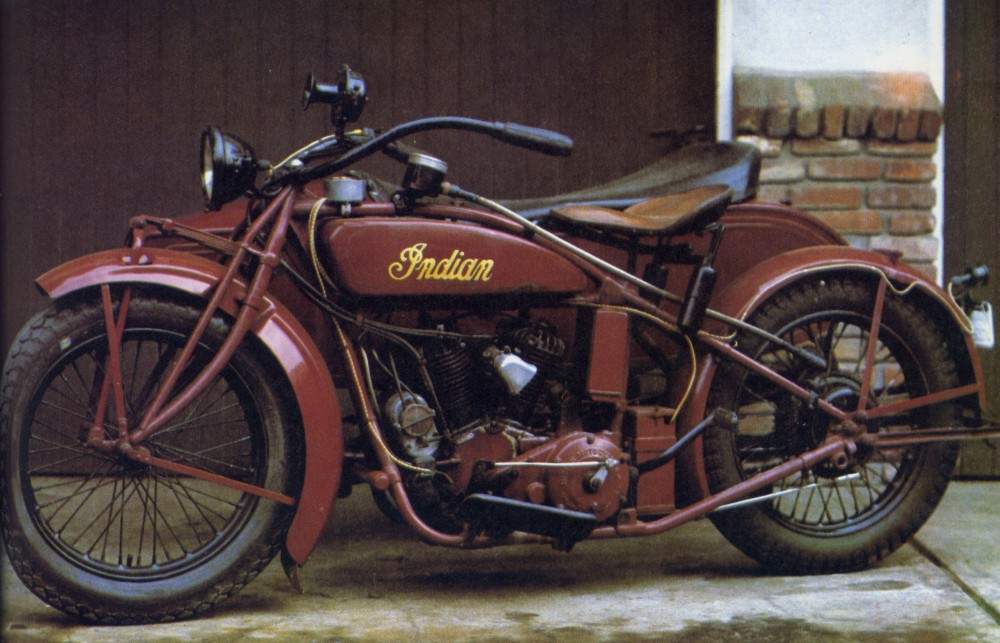
Indian Big Chief


American enthusiasts have always held to the belief that bigger is better. It's a philosophy which is not always shared by the rest of the world, but it does explain the sheer bulk and weight of the typical American motor cycle of the interwar years
Strictly speaking, the 74 cubic inch (1213cc) Indian Big Chief existed from 1923 to 1928 only, although a 74cu in engine had been available as an alternative to the standard 61 cu in power unit of the Chief from 1920 onward.

The emergence of the Big Chief as a model in its own right came about because Indian dealers were clamouring for still more speed, power and stamina. Dublin-born chief engineer Charles B. Franklin set to work to give them what they wanted. Instead of boring-out the Chief engine to provide the extra capacity he enlarged the bore by only 1/8in but lengthened the stroke considerably.

The outcome was an L-head side-valve with a loping stride and a top speed of nearly 90 mph.
The performance improved still more when in 1927 detachable cylinder heads incorporating
combustion chambers designed by Harry Ricardo were fitted. In 1928, the Big Chief (marketed in England as the Super Chief) received 19 x 3-85in low-pressure balloon tyres for a more comfortable ride, and restyled handlebars which gave a more relaxed riding position.

From the first, the Big Chief was equipped with helical-tooth primary gears and an integral three-speed gearbox. The Splitdorf magneto was gear driven and while European motor cycles still made use of the archaic lever throttle, Indians controlled the Schebler carburettor by means of a twistgrip.
In earlier years, Indian twins had enjoyed a moderate following in Britain, but coincidental with the introduction of the Big Chief came the imposition of a 33-1/3 per cent import duty on USA-made motor cycles (in fact, a retaliation for the American tariff wall against British goods). As a result, the machine was listed on the British market at £97, well above the cost of home-built models, and very few were sold.

Already the machine weighed a hefty 425 lb, and as time went by it was to grow weightier still. Another point in its disfavour was that, like most American makers, Indian fitted a rear wheel brake only.
By way of diversion, around 1928 the factory was experimenting with a light car carrying a very English-looking bodywork. Under the bonnet however, was the familiar 74cu in Big Chief engine, driving by chain to a rear axle differential. Why Indian should have been pursuing such a course at this time is hard to understand, because the air-cooled cyclecar had long since had its day. Anyway, the project was dropped before getting beyond the prototype stage.
Not until 1929 did Indian fit a front brake, but when that season's models were revealed it was seen that—in name at least—the Big Chief was no more. In truth it was the 61 cu in twin that had been phased out, but the Chief name had been transferred to the bigger machine.

That was the way it was to be on into the 1930s when, for a time, the big solo was partnered by a Chief-engined three wheeled delivery van. In the final years of producion at the Springfield, Massachusetts, works, the 74cu in twin adopted deep-flared mudguards and even plunger-type rear springing, but by 1950 it had died.

Specification

(1923 model)

engine frame
Air-cooled, four-stroke, Single tubular cradle
twin-cylinder. suspension
83 mm (325in) boreX Front - Trailing-link fork with
113 mm (4-44in) stroke = leaf springing
1213cc (74cu in). Maximum Rear - Solid unsprung
power 24 bhp at 3000 rpm. brakes
Two side valves per cylinder Front - none
operated via rockers by two Rear - Drum 6.8in
camshafts. weight
Single carburettor 425lb (193kg)
transmission performance
Three-speed gearbox. Chain Maximum speed—90 mph
drive to rear wheel

Source Super by Bikes Loure Caddell


NOTE: Some of the photos on Motorcycle Specs are owned by somebody. If you see any of your photos, you can let me know so that I can acknowledge it, or if you object to it, I can remove it altogether. If any copyright holder objects  to their articles being placed on Motorcycle Specs, it will be removed upon request.  Any correction or more info on these bikes will kindly beappreciated                                          Contact Me      Privacy Policy     Website Stats