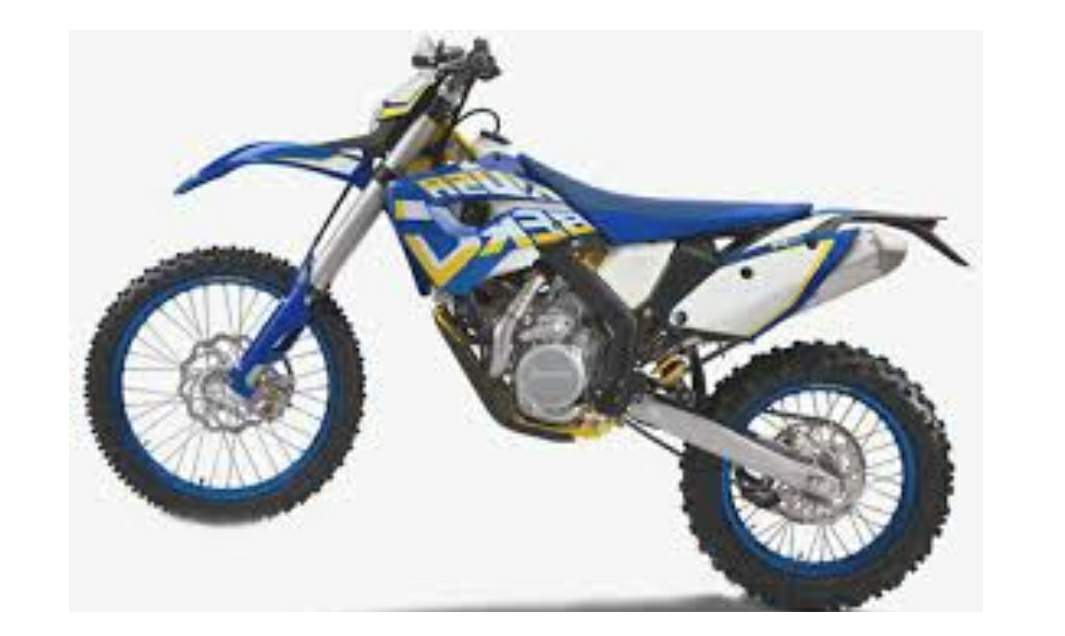
|
Husaberg FE 501e Supermono

|
Make Model |
Husaberg FE 501e Supermono |
|
Year |
2000 |
|
Engine |
Liquid cooled, four stroke, single cylinder, 4 valves per
cylinder. |
|
Capacity |
501 |
|
Bore x Stroke |
95 x 70.1 mm |
|
Compression Ratio |
|
|
Induction |
|
|
Ignition /
Starting |
|
|
Max Power |
|
|
Max Torque |
|
|
Transmission /
Drive |
6 Speed / chain |
|
Front Suspension |
|
|
Rear Suspension |
|
|
Front Brakes |
Single 260mm disc |
|
Rear Brakes |
Single 220mm disc |
|
Front Tyre |
90/90 -18 |
|
Rear Tyre |
140/80 -18 |
|
Dry-Weight |
109 kg |
|
Fuel Capacity |
9 Litres |
New commitment to service / warranty...
Perhaps the most important step in the right direction has come with an increase
of the normal 3 month warranty out to 12 months. Husaberg now offers a better
warranty than bikes like its KTM brethren (3 months) and Yamaha's WR models.
Husaberg management claim that they are now totally committed to after sales
service and support, an area where the brand has been lacking in previous years.
Perhaps even more important for customer satisfaction is that all 2003 Husaberg
machines are put through an extensive pre-delivery regimen at the WA based
national distribution centre, before being sent on to dealers.
Nothing like your new bike leaking oil the first week you get it, this new
system of doing things hopes to prevent such happenings.
Husaberg also claim to be working hard to ensure a large stock of components and
service items are always available and warehoused at their Australian
distribution centre. I was impressed with my walk around their facility, the
manager I spoke to impressed with his common sense approach to how he aims to
improve the name of the brand.
Husaberg - History
The Husaberg brand came about from a group of Husqvarna engineers breaking away
from Husky to produce their own machines.
They had immediate success in European racing circles and started producing
machines for sale. They were then brought in to the KTM fold to help them
develop Husaberg further.
In recent years KTM has learnt many lessons in areas of quality control and
parts distribution, and this is where the benefits for Husaberg will show
through. But each company’s products will remain totally separate.
Now to the bike
I recently covered over 600km aboard one of Husaberg’s FE501 machines.
For this review I sampled the model with some optional ‘SuperMoto’ components,
including polished 17” rims shod with Michelin Sport road rubber. An impressive
Inox 310mm floating front disc assembly with Beringer four-piston caliper was
also an optional extra fitted to the machine.
The FE501 retails for around $12,595, the road wheels and brake are available
separately but will add nearly $3000 to the cost of the machine. But then you
have a road bike and MX bike in one, you only need to switch the wheels over
depending on what you plan to get up to over the coming weekend.
The brake is powerful and does not fade. The disc rotor is fully-floating, thick
and robust. Effort through the lever is moderate and feel is quite good.
Combine the impressive braking forces with the motocross based suspension and it
is easy to see that in Supermoto trim the machine would benefit from some
stiffer springs in the forks, along with a reduction in travel. Husaberg can
supply off-the-shelf components to make this simple modification a fuss free
affair.
The soft forks held things back a little when braking hard. Also on the exit of
fast turns when carrying good corner speed the forks were prone to 'pattering' a
little. We were getting pretty excited on the machine though and circulating the
Wanneroo short-circuit in around 61 seconds.
However, the rear suspension was impressive in Supermoto trim. The progressive
PDS shock behaved extremely well and did not suffer from excessive squat or
instability, common on such machines when road rubber is fitted. You would have
to be getting fairly serious at the track before any changes to the rear shock
were necessary.
The 501cc engine is really strong off the bottom. Surprisingly, it is also quite
smooth running thanks to a counter-balancer running off the crankshaft. We ran
it up on the dyno at Witch Cycles and saw that it pretty much matched the
renowned master of four-stroke grunt, KTM’s 520 EXC, throughout the whole rev
range. (Click here for dyno charts).
The more observant among you may have noticed there is no airbox visible on the
machine. That is because the 40mm Dellorto carburettor breathes through the
frame. The air-filter sits atop the backbone of the frame just under the fuel
tank. The air is then passed through the frame to the carburettor.
Electric start is provided, a kick-starter is also fitted. Like most of the more
competition-based machines the electric start is handy, but can’t always be
relied upon. However it was more reliable than some of the European dirt
machines I have sampled, it worked all but a couple of times. However, it must
be said that as I got more accustomed to the machine starting became much
easier, as is normal with a dirt based machine.
The kick-starter is on the left-hand side of the machine and is aided by an
automatic decompressor. A handlebar mounted decompression lever also helps
should everything else fail.
The choke is out of the way under the tank of the machine. It is operated by
pulling down and twisting rather than the conventional pull in/out type toggle.
You have no hope of operating it on the move, luckily it is only needed to fire
the beast from very cold and can be disengaged immediately after starting.
The standard muffler is easily derestricted and provides one of the nicest
four-stroke single notes I have heard. In derestricted guise it is not overly
loud but it does have enough bark to provide aural appeal when ‘getting up it’.
On the move the six-speed gearbox is a gem, clutchless upshifts are always
smooth and positive. However finding neutral can sometimes be a little
troublesome.
The 9-litre fuel tank is made by Acerbis and has a fuel tap on either side of
the machine. A reserve position is shown on the taps but as I found out to my
cost, it is there more for show than use. There is actually no reserve cell in
the tank. Thanks to the kind gentleman who gave me a lift to the service
station. Fuel range is less than 100km in most conditions.
Exotic components abound including Magura tapered bars, CrMo frame, 48mm USP WP
forks, WP PDS shock and Brembo master cylinders/levers etc. (See detail shots at
bottom of page - click them to enlarge). Unnecessary extras are kept to a
minimum so the machine can tip the scales at a fraction over 110kg dry.
The dash is small and comprehensive. It offers many functions such as tripmeters
and countdown trips to aid enduro navigation and also features an onboard lap
timer function. The buttons to operate the unit are on the left bar, see picture
at bottom of page. On the right bar is another switch that allows the rider to
switch between two ignition maps as conditions change.
In SuperMoto trim the machine is an absolute hoot on the street. Every
roundabout has you begging to throw the machine in sideways and self-control
becomes a premium commodity. I didn't really want to take it back after my 600km
stint with the bike. But I think my licence is more safe for it...
Down the track we also hope to review the 501 Husaberg as it comes out of the
box in the conventional enduro guise. Husaberg also sell a ready to go SuperMoto
model called the FS650.
Source MCNews..au
|