|
|

|
|
|
|
Classic Bikes
Custom Bikes
Individual
Racing Bikes AJP
AJS
Aprilia
Ariel
Avinton / Wakan
Bajaj
Benelli
Beta
Bimota
BMW
Brough Superior
BRP Cam-Am
BSA
Buell / EBR
Bultaco
Cagiva
Campagna
CCM
CF Moto
Combat Motors
Derbi
Deus
Ducati
Excelsior
GASGAS
Ghezzi Brian
Gilera
GIMA
Harley Davidson
Hero
Highland
Honda
Horex
Husaberg
Husqvarna
Hyosung
Indian
Jawa
Kawasaki
KTM
KYMCO
Laverda
Lazareth
Magni
Maico
Mash
Matchless
Mondial
Moto Guzzi
Moto Morini
MV Agusta
MZ / MuZ
NCR
Norton
NSU
Paton
Peugeot
Piaggio
Revival Cycles
Roland Sands
Royal Enfield
Sachs
Sherco
Sunbeam
Suzuki
SWM
SYM
Triumph
TVS
Ural
Velocette
Vespa
Victory
Vincent
VOR
Voxan
Vyrus
Walt Siegl
Walz
Wrenchmonkees
Wunderlich
XTR / Radical
Yamaha
Zero
Video
Technical
Complete Manufacturer List
|
Coventry Eagle
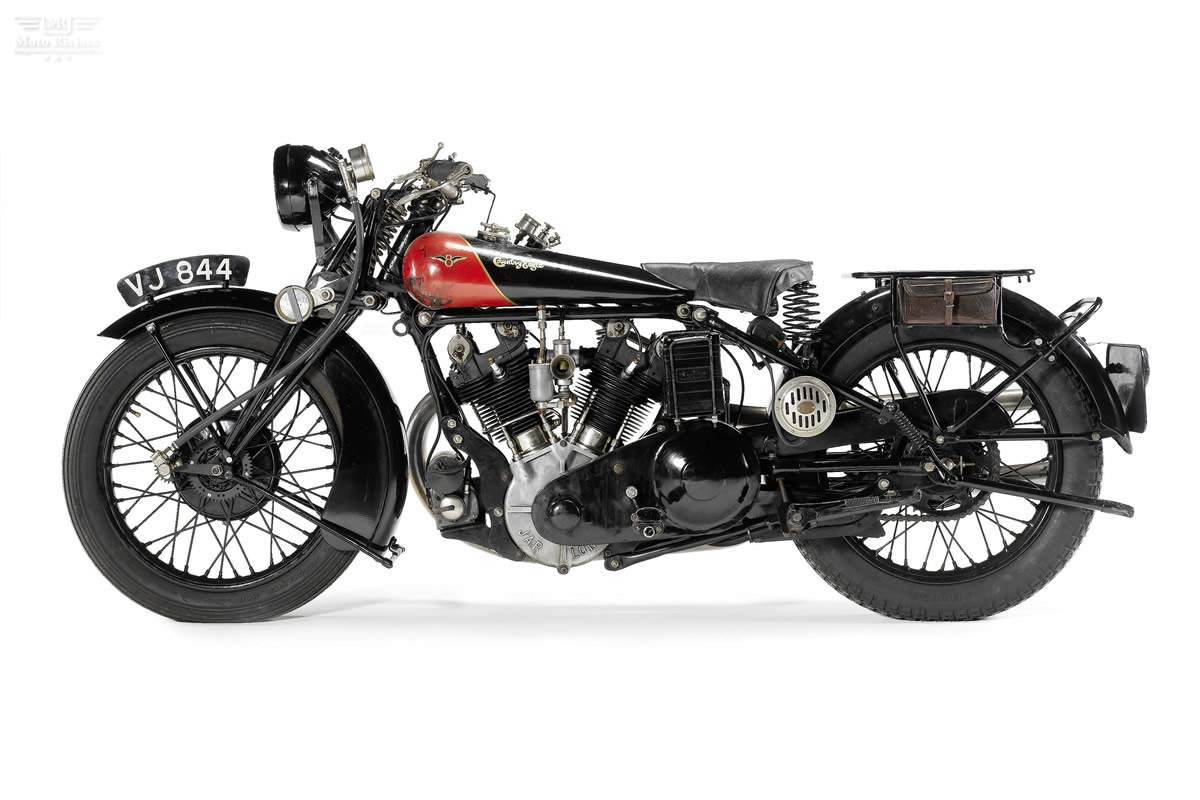
Imagination pictures the Roaring Twenties as a time of long summer days, a punt on the river, blazers and broad-bottomed flannel bags and voh-de-oh-doh music from a wind-up portable phonograph; and somewhere not far away, there would be a long lean-looking bike with a bulbous tank and powerful 976cc vee-twin engine. A Brough Superior? Possibly, though not necessarily, because there were plenty of other models in the Brough mould —like AJW, fvlcEvoy, Coventry-B&D, Grindlay Peerless, and Croft Cameron. And there was Coventry Eagle, the most Brough-like of them all. Yet it would be a mistake to discount the
Coventry Eagle Flying Eight as just a slavish copy. It was more a case of 'great
minds think alike', because George Brough and Percy Mayo were student friends
who, as World War I came to a close, would often talk far into the night about
the dream bikes that each would build, once peace came again. They commented also that the finish was of the
very finest—and so it was, with the bullnosed saddle tank (used on smaller
Coventry Eagles for the past season, be it noted) decked out in black and
carmine red. From the start, it had all-chain drive and a
three-speed Sturmey Archer gearbox, and despite the daunting price of £145
(extremely high for the period) it attracted a discerning clientele.
There were even better things to come from Coventry Eagle, however. They enlisted the aid of Brooklands racing star Bert Le Vack, and Bert's track experience led to the development of a whole family of Flying Eights for the 1925 season, all making use of a lighter yet stronger frame. Other details included a Webb centre-spring front fork, Sin-diameter Royal Enfield brakes and, on the top-of-the-range model, a Jardine gearbox. That top model employed for the first time an overhead-valve 976cc twin —the same JAP power unit as that found in George Brough's new SS100 Brough Superior. There was a standard two-cam side-valve at £120, a four-cam side-valve (this was another new JAP motor, powering the Brough SS80) at £ 135, and the overhead valve job at £ 165. Oddly enough, in each instance these prices were just £5 under those of the equivalent Brough Superior. Coincidence or collusion? Apart from cosmetic changes such as a more handsome headlamp, a better layout of the twin exhaust pipes, and the adoption of Whispering Ghost silencers, there was little further change in the make-up of the Flying Eight. One more version was added in 1927 only, a bargain-price two-cam side valve offered without electric lighting and it could be that this was an attempt to clear the decks, prior to a change of policy by the Mayo family. That year there had been a significant addition to the Coventry Eagle programme, in the form of a Villiers-powered two-stroke in a new pressed-steel frame. The last Flying Eights were catalogued for I929, and by then the teething troubles of the pressed-steel frame had been overcome. The future, reckoned the Mayos, lay not so much in expensive vee-twins as in cheap commuter models. Time was to prove them right. Specifications (1922 model) engine Source Super by Bikes Loure Caddell
|
|
|
Any corrections or more information on these motorcycles will be kindly appreciated. |